VCDX Book Giveaway

Due to a technicShowCoverVCDXal oversight yesterday at London VMUG, Gregg Robertson and I forgot to give away the excellent VCDX Boot Camp book during our ‘VCDX Application – What Does IT Take?’ presentation.

Written by John Arrasjid, Ben Lin and Mostafa Khalil the book is aimed at anyone who is embarking on the journey towards the elite certification.

The main chapters are:

  1. Certification Overview
  2. Preparation
  3. The Design
  4. Defense Overview
  5. Design Defense
  6. The Design Scenario
  7. The Troubleshooting Scenario

The book provides an in depth look into how the certification was formed and what the panellist expect from a candidate.

To add this book to your collection, just complete the form below on or before 9PM Friday 23rd May 2014.

The winner of the book will be drawn on 24th May 2014 and will be notified by email.

Note: The giveaway is open to anyone

← Back

Thank you for your response. ✨

London VMUG 15/07/2014 – Get Some

The next London VMUG is happening on Thursday 15th May 2014, so if you haven’t registered for the event yet, I urge you to get involved.

Click the link to register

The committee members have some great sessions lined up,  including:

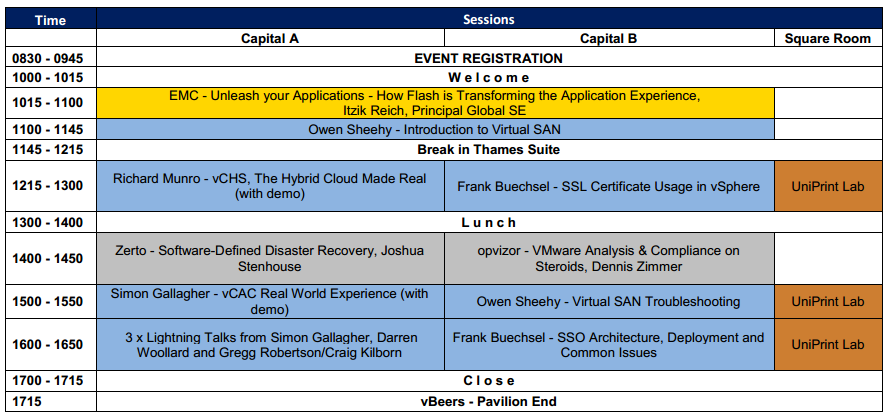
  • Owen Sheehy – Introduction to Virtual SAN
  • Frank Buechsel @fbuechsel – SSL Certificates and SSO Architecture

VMUG

If you want a chance to heckle Gregg Robertson @GreggRobertson5 and I come along to our ‘lightning talk’ on what it takes to submit for VCDX.

London Chamber of Commerce and Industry
33 Queen Street
London EC4R 1AP

VCDX Submission – By The Numbers

Prerequisite

I’m sure all of you know that the prerequisites for VCDX are VCP and both VCAPs.  I started the process of trying to achieve the VCDX certification back in October 2013, when I passed the VCAP-DCD and then two months later in December 2013 I achieved VCAP-DCA status.

I didn’t keep a log for the effort I put into the VCAP-DCA, but I believe it was approximately one month of study time, to get to a point where I felt I had a chance of passing.

Family Life

Why have I mentioned ‘family life’ in this blog post? Seems kinda irrelevant?  Well I would say it’s probably the most important part of the VCDX Submission process.

This point is crucial, do not underestimate how hard it is not spending time with your family (I have two children 2 and 6), you will be giving up your weekends, ability to attend family functions, time with your friends and doing the things you enjoy outside of work.

In December 2013 and January 2014, it was holiday season and I wanted to spend time with my family and to see if my better half would commit to the VCDX process, as I knew it would be grueling on the both of us.  My amazing wife said yes and it was time to find a design.

I was conversing with Paul Meehan @PaulPMeehan on twitter about the virtues of VCDX and he mentioned that the word VCDX had taken pride of place next to ‘Voldemort’ in things that should not be mentioned in the Meehan household.

Design

Finding a design which meets the design qualities for VCDX Submission is hard work, not every customer you work with has a design that meets the required standard for Availability, Manageability, Performance, Recoverability, Security.

I was pretty new to my current role, four months in and even though I had designed a number of upgrades and solutions, I didn’t believe any of them ‘cut the mustard’ in terms of design qualities.  I was working with a number of clients and knew I had something in the pipeline, but you are never sure if you will be the Lead Architect on the design or whether the clients circumstances would change.

So in the end, I decided to use a design I had done for a customer back in 2012!

The bad news was that it was going to take me sometime to get back up to speed on the design, but the good news was it ticked every one of the design qualities.

VCDX Submission

The VCDX Submission is broken down into the following key areas:

  • Architecture Design
  • Installation Guide
  • Validation Test
  • Implementation Plan
  • Operational Procedures
  • Application Form

So how long has it taken me to get to a point of being able to submit for VCDX?

Overall Total

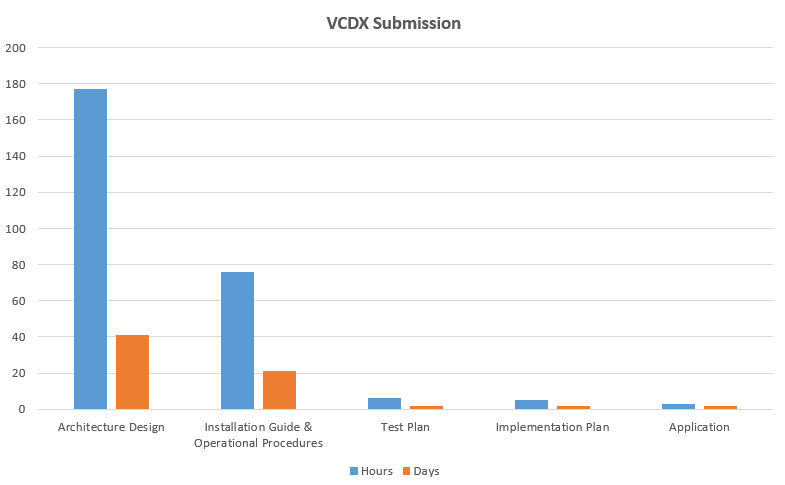
267 Hours

68 days

Average 4 Hours per day

equivalent to 5 weeks annual leave and every bank holiday throughout the year!
VCDX Submission

Architecture Design

177 Hours

41 Days

4 Hours 20 Minute Average

239 Pages

112 Tables

34 Diagrams

To complete the first draft took from 1st February 2014 to 9th March 2014 and consisted of 34 days and 149 hours of effort.   The remaining time of 28 hours was reviewing and tweeking.

equivalent to a working month at 40 hours per week over four and a half weeks

Installation Guide & Operational Procedures

I decided to combine the installation guide and operational procedures as it made sense.

76 Hours

21 Days

3 Hours 40 Minute Average

141 Pages

14 Tables

57 Diagrams

To complete the first draft took from 10th March 2014  to 31st March 2014 and consisted of 17 days and 70 hours of effort.   The remaining time of 6 hours was reviewing and tweeking.

equivalent to two weeks annual vacation for someone who works 38 hours per week

Test Plan

6 Hours

2 Days

3 Hours Average

124 Tests

Implementation Plan

5 Hours

2 Days

2 Hours 30 Minutes Average

182 Project Line Items

Application

3 Hours

2 Days

1 Hours 30 Minutes Average

Peer Review

Not added to the list is a review of my VCDX Architecture Design by colleague and all round good ‘egg’ Steve Wenban @stevewenban79

414 Minutes

178 Comments

7 instances of vCentre corrected

1 big thumbs up

VCDX Paying It Forward

I was trying to think of a title for this blog post, numerous thoughts crossed my mind, VCDX Boot Camp, VCDX Mentoring and VCDX Frimley.  However ‘VCDX Paying It Forward’ seemed the most appropriate.

Yesterday I attending the VCDX Boot Camp, ran by John Arrasjid @vcdx001 and Mostafa Khalil @MostafaVMW at VMware Frimley

It was clear as soon as I heard John speak, that he is articulate, passionate and dedicated to enabling the VCDX programme.  The boot camp for those that don’t know is free, ran at the cost of VMware to enhance the potential success rate of candidates embarking on the elite certification.

of the 15 candidates who attempted VCDX, the 9 who attended the VCDX boot camp passed first time

John went onto explain why VMware runs the boot camps for free

 pay back for VMware is having architects who can understand business needs and meet there requirements, creating infrastructures that need less support and enhance VMware product placement and sales

VCDX Mentoring Programme

On the 1st April 2014, VMware launched the VCDX Mentoring Programme.  This is designed to help candidates by aligning a current VCDX to be a mentor throughout the process.  John went on to mention that this is being undertaken by a limited number of current VCDX who are giving up their own personal time to help so priority will be given to candidates who are further along the process.

To find out more details contact @vcdx001

VCDX Tips

These are in no particular order, but I hope they help anyone who is embarking on the journey.

  • VCDX is about finding the minimally qualified candidate
  • If your application is accepted to defend, then you have a chance of passing VCDX
  • Applications are given a higher or lower weighting
  • Each question is an opportunity to score points, increasing or decreasing your overall score
  • Questions are asked to clarify knowledge and understanding of an area
  • Improve your week areas, understand all aspects of the design and be clear on solution areas – no ambiguity
  • If you have a really detailed physical design, show this from a birds eye view.  Have other diagrams that zoom/focus in on key areas
  • When troubleshooting, ask general questions about storage, networking, compute and then dive down deeper based on answers given
  • Respect time constraints, keep answers clear and to the point
  • The minimum architecture design is around 150-200 pages, however quality not quantity matters
  • Business requirements drive the design.  Which must be suited for business critical applications in a managed environment
  • VCDX designs are reviewed twice, once on application and then again before the defense. The original reviewer might not be the panelist
  • VCDX candidates show mastery of implementation guidance, risk identification and mitigation and are complete, clear and concise.
  • In the VCDX design scenario defense you can ask the panelist to look up server make/model if you are unsure of what they are
  • In the VCDX troubleshooting defense you can ask the panelist to be the calculator for you (let them do the math!)
  • In the VCDX troubleshooting defense you can ask the panelist to reboot an ESXi Host and they can tell you the results
  • In the VCDX design scenario defense use the whiteboard to sketch ideas and make notes
  • In the VCDX design scenario defense ask the question ‘what are your priorities’ to understand which requirements are the most important
  • Don’t assume all information is correct in design scenarios, check and validate the data
  • When troubleshooting, think about your back out plan if something goes wrong

VCDX Design Process

The boot camp is used to explain the process of the overall design process which can be summarised as:

Inputs

  • Design Process Inputs
  • Interviews with stakeholders
  • Workshops
  • Capacity Planner
  • Security & Compliance investigation

Outputs

  • Requirements
  • Constraints
  • Risks
  • Assumptions
  • Out of scope
  • Conceptual
  • Logical
  • Design Considerations
  • Diagrams Tables

An example of a VCDX design can be found in vCloud Architecture Toolkit vCAT 2.0.  Examples are shown at the bottom of the page, look for Private VMware vCloud, Public VMware vCloud and Hybird VMware vCloud

VCDX Social

Apart from understanding the VCDX process, it was great to meet up with so many individuals who had traveled from around Europe to attend the boot camp.  We have a strong community who are willing to give up their own time to help others.   If you are thinking about or are starting on the VCDX journey I strongly recommend you follow these individuals blogs or Twitter stream:

Name Twitter Blog
Manfred Hofer @Fred_vBrain vbrain.info
Gregg Robertson @GreggRobertson5 thesaffageek.co.uk
Sam McGeown @sammcgeown definit.co.uk
Seb Hakiel @SebHakiel vwired.co.uk
Steven Dunne @stevied_82 virtuallyvirtuoso.com
Paul McSharry @pmcsharry elasticsky.co.uk
Ray Heffer @rayheffer rayheffer.com
Matthew Bunce @virtualisedgeek virtualisedgeek.com
Simon Davies @EV_Simon everything-virtual.com
Ross Wynne @RossWynne wynner.eu

VCDX Boootcamp


2014 Top vBlog Results

2014_Award-Banner_Top-50For the last six years Eric Siebert has been running the annual top virtualisation blog poll over at vSphere-Land

This takes a tremendous amount of time on Eric’s behalf to not only market the awards, but to organise gifts from the vendor community.  This year awards included Asus Nexus 7 Tablet and a Google Chromecast.

It was great to see a number of blog’s that I regularly visit rising up the ranks, these include:

Everyone on the list takes time out of their busy schedules to create content to be consumed by others, whether this is for a new product, a how to guide or resolving an issue.  For me, this is something that I never fail to recognise.

I’m pleased to say that VMFocus.com has made the top 50, coming in at number 42.  I know it sounds corny, but I was genuinely shocked by this.  So a thank you to everyone who took the time out to vote for me and everyone else on the list.  We all do appreciate it!

If you fancy watching the results show, head over to YouTube and give Eric Siebert a Like