Upgrading To Horizon View 5.2 – Security Server

The good news is that to upgrade the Security Server we use the Connection Server installer from here and at the time of writing the latest release is VMware-viewconnectionserver-x86_64-5.2.0-987719.exe

Launch the installer

View Security Server 1

Click Next

View Security Server 2

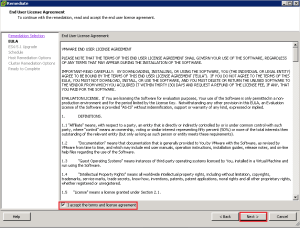
Accept the EULA

View Composer Upgrade 3

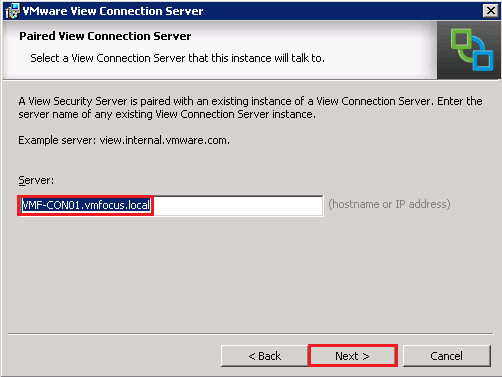
Verify that your Connection Server FQDN is correct

View Security Server 3

Next we need to jump into the View Administrator and go to View Configuration > Servers > Connection Servers > More Commands > Specify Security Server Pairing Password

View Security Server 4

Cool, once you have done this, enter the same password on the Security Server installation and click Next

View Security Server 5

Verify your URL’s for your Security Server and click Next

View Security Server 6

Choose ‘Configure Windows Firewall Automatically’

View Security Server 7

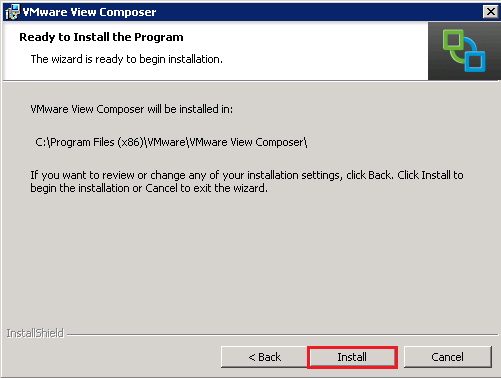
Now let’s click Install

View Security Server 8

Quite a quick installation, hopefully you should have the Finish button available.

View Security Server 9

As always, we are going to give the server a reboot and check Programs & Features to make sure we are running the correct version.

View Security Server 10

Upgrading To Horizon View 5.2 – Connection Server

In the last blog post we upgraded our Composer Server which was straight forward (great job VMware).  Next we need to upgrade the Connection Server.

The upgrade process is in two parts, first of all we need to upgrade the Connection Server and then install HTML Access.

Connection Server

The first thing we are going to need is the right installer.  These can be found from here and at the time of writing the latest release is VMware-viewconnectionserver-x86_64-5.2.0-987719.exe

Launch the installer

Connection Server Upgrade 1

Click Next

Connection Server Upgrade 2

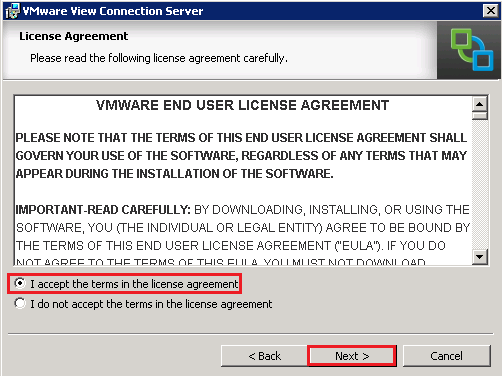
Accept the EULA

Connection Server Upgrade 3

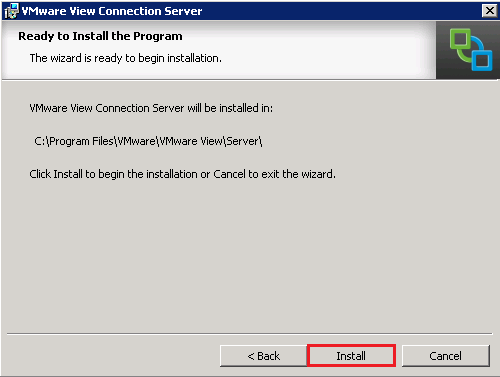
We are now ready to install.  Hit the button!

Connection Server Upgrade 4

This is going to take a little while, so I suggest you make a quick brew.

Connection Server Upgrade 5

All done, now you don’t have to reboot, I just prefer to do this to make sure everything is correct.

Just to verify, let’s check Programs & Features to make sure View Connection Server is on the right release.

Connection Server Upgrade 6

Horizon View 5.2 HTML Access

Right then, let’s crack on with the Horizon View HTML Access.  This can be found from here and at the time of writing the latest release is VMware-Horizon-View-HTML-Access_x64-1.0.0-1049726.exe

Launch the installer

Connection Server Upgrade 7

Click Next

Connection Server Upgrade 8

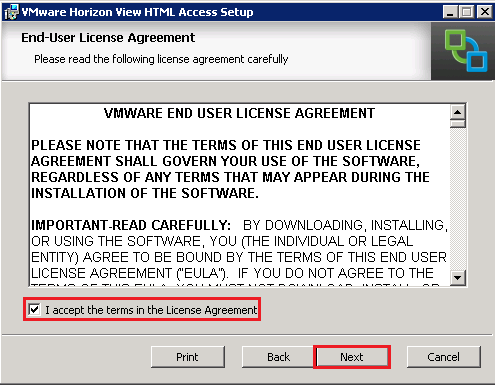
As always, we need to Accept the EULA

Connection Server Upgrade 9

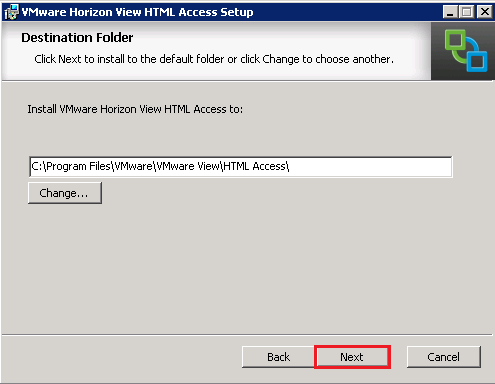
Choose your installation folder, as always stick to the defaults unless you have a good reason not too.

Connection Server Upgrade 10

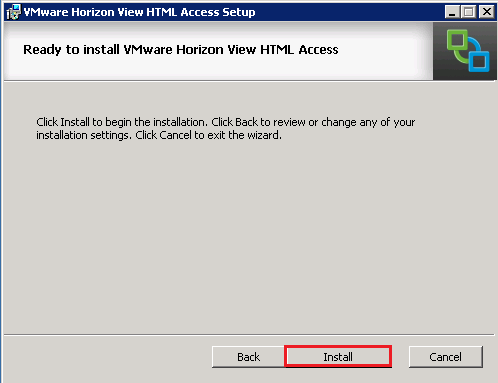
Voila, let’s click the Install button

Connection Server Upgrade 11

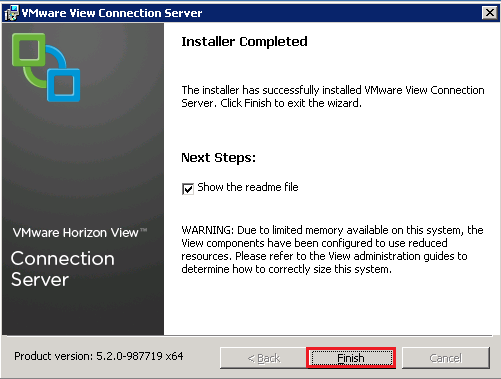
The install is really quick, hopefully you should see Finish.

Connection Server Upgrade 12

All done, now you don’t have to reboot, I just prefer to do this to make sure everything is correct.

Just to verify, let’s check Programs & Features to make View Horizon HTML Access is installed.

Connection Server Upgrade 13

Upgrading To Horizon View 5.2 – Composer Server

Horizon View 5.2, brings with it a host of new features.  The one which I’m most excited about is being able to access your desktop from any HTML5 browser without the need for the View Client.  A list of enhancements is shown below (source VMware View 5.2 release notes)

What’s New with End User Experience

  • Support for Windows 8 based desktops1
  • Hardware Accelerated 3D Graphics1
  • Improved video and VOIP communications with Microsoft Lync 2013 support4
  • Streamlined access to View Desktops from Horizon2
  • Easily connect to desktops from any device with HTML Access3
  • Enhanced productivity from mobile devices with new ‘Unity Touch’ functionality3 and 4

What’s New with Ease of Management

  • Large pool creation with elimination of 8 host limits, and multiple vLAN support
  • View Administrator performance improvements with large numbers of desktops
  • Accelerated provisioning and recompose operations.
  • Tech Preview of a new Integrated Service Console in the vSphere Web Client1
  • Support for vCenter Server Virtual Appliance based deployments

What’s New with Total Cost of Ownership

  • Substantial storage capacity savings for persistent desktops with space-efficient (SE sparse) disk technology1

1 Requires use of vSphere 5.1 and subsequent patches
2 Requires use of VMware Horizon Suite
3 Requires use of additional VMware Horizon View 5.2 Feature Pack
4 Requires use of latest VMware Horizon View Clients

Upgrade Process

Before we embark on this upgrade process, the number one rule is to get a good backup.  Once you have this, then the number two rule is to follow the official documentation which can be found here.

The order in which I’m going to tackle the upgrade is as follows:

  1. View Composer
  2. View Connection Server including Horizon View Feature Pack 1
  3. View Security Server
  4. View Transfer Server
  5. View Agent
  6. View Client

View Composer

In my home lab, View Composer is sitting on my vCenter Server, so the first thing we are going to do is download the correct installer.  These can be found from here and at the time of writing the latest release is VMware-viewcomposer-5.2.0-983460.exe

Launch the installer

View Composer Upgrade 1

Click Next

View Composer Upgrade 2

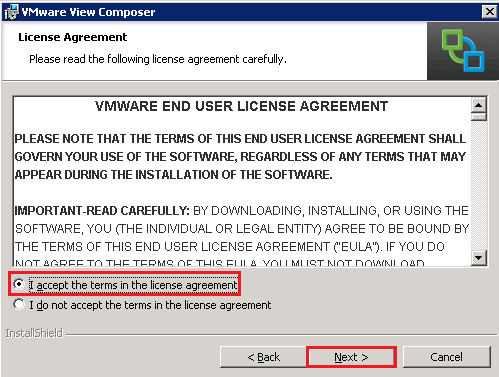
As always we need to accept the EULA

View Composer Upgrade 3

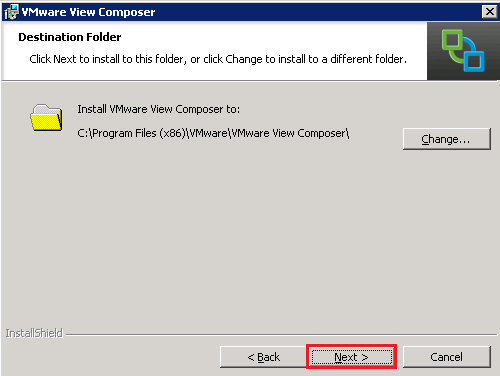
Select the install location, I advise leaving this as the default unless you have a good reason not to.

View Composer Upgrade 4

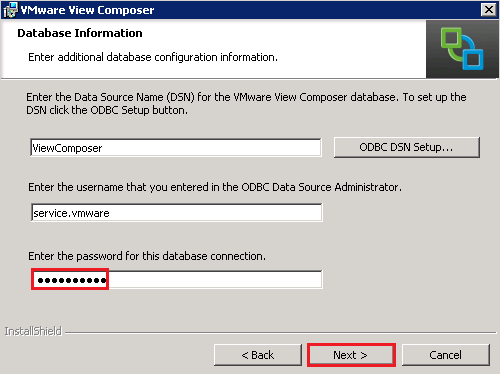
The next bit could be tricky, if you have forgotten your passwords as View needs to upgrade the database.  Enter your credentials and click Next

View Composer Upgrade 5

We are gong to create a new default SSL certificate and click Next

View Composer Upgrade 6

If everything is golden, you should see the Install button.  Give it a Click.

View Composer Upgrade 7

The install takes a few minutes so you might want to get yourself a cup of tea.

View Composer Upgrade 8

After hitting finish, we need to give our vCenter Server a reboot.  Click Yes and I will see you on the other side.

View Composer Upgrade 9

To make sure everything is ‘tickety boo’ if you check Programs & Features to verify your install package.

View Composer Upgrade 10

Veeam On Tour

Thought I would let you know that Veeam are on tour, putting together some roadshows in the UK.

They have three events over the next few days (bit of a sporting theme)

  • Twickenham Rugby Stadium – London on April 23rd
  • Manchester United Stadium – Manchester on April 24th
  • Murrayfield Rugby Stadium – Edinburgh on April 25th

The events are focused on the latest updates about the Veeam product features, so expect lots of V7 goodness.  Also you will have an opportunity to learn best practices for implementing Veeam solutions.

A typical agenda is shown below.  To register click me

14:30 – 15:00 Registration
15:00 – 15:30 Introduction to Modern Data Protection: Powerful, Easy–to–Use, Affordable!
15:30 – 16:00 Customer Success Story – What were the challenges Veeam customer faced before implementing Veeam and what are the results after the implementation
16:00 – 16:45 Live demo
16:45 – 17:00 What’s next at Veeam
17:00 – 17:15 Interactive Q&A session
17:15 – 18:30 Buffet and networking with Veeam

If you aren’t able to make it in person and want to be their in a virtual capacity, then Veeam have put together a Webcast, to register click me

14:00 – 14:30 Introduction to Modern Data Protection: Powerful, Easy–to–Use, Affordable!
14:30 – 15:00 Customer Success Story – What were the challenges Veeam customer faced before implementing Veeam and what are the results after the implementation
15:00 – 15:45 Live demo
15:45 – 16:00 What’s next at Veeam

How To See Local RAID in ESXi 5.1

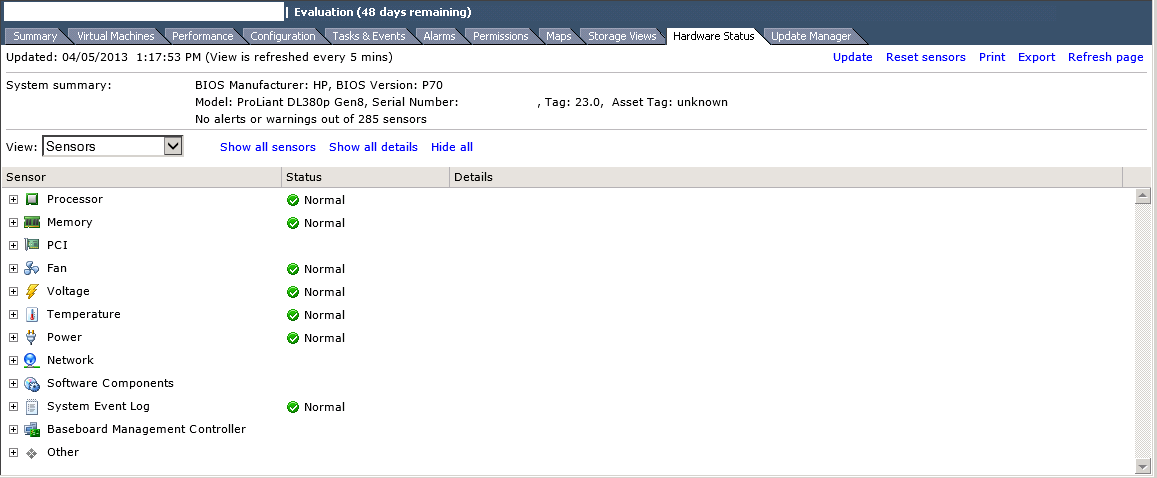
One of my work colleagues Mat Smith pointed out that when you install the generic ESXi hypervisor from the VMware site you get basic HP or Dell hardware information which is OK, but if you only have local storage you don’t know what state the underlying RAID configuration is in unless you have access to iLO or DRAC.
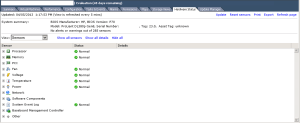
ESXi01 Hardware

This can be easily rectified by downloading the latest HP Custom Image for ESXi 5.1.0 ISO at the time of writing this blog post, the latest update is VMware-ESXi-5.1.0-799733-HP-5.34.23.iso

Once you have downloaded the ISO go into Update Manager > Admin View > ESXi Images and Select Import ESXi Image

ESXi Images 1

Select your the HP Custom Image for ESXi 5.1.0 ISO and click Next

ESXi Images 2

It should only take a minute or so and you will see the HP Custom Image for ESXi 5.1.0 ISO has been uploaded.  Once done hit next.
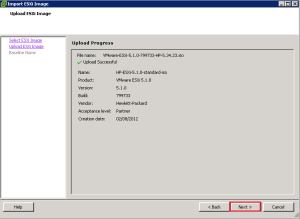
ESXi Images 3

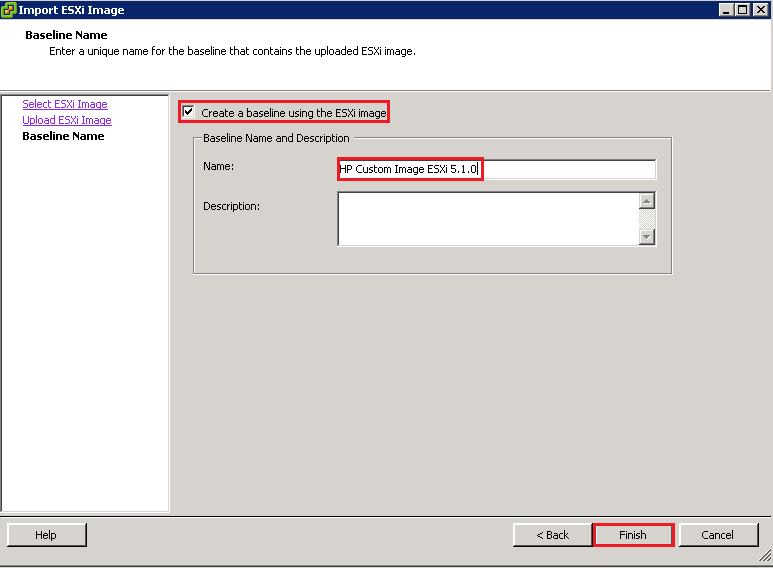
Next we need to create a a baseline image, I’m going to roll with HP Custom Image ESXi 5.1.0 then click Finish

ESXi Images 4

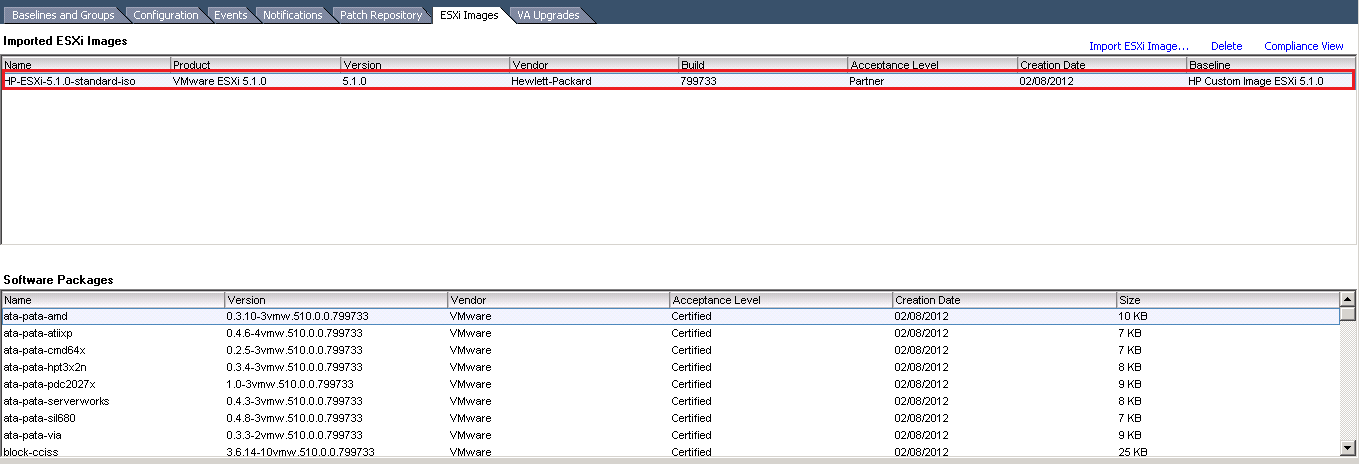
Fingers crossed you should see the Imported Image

ESXi Images 5

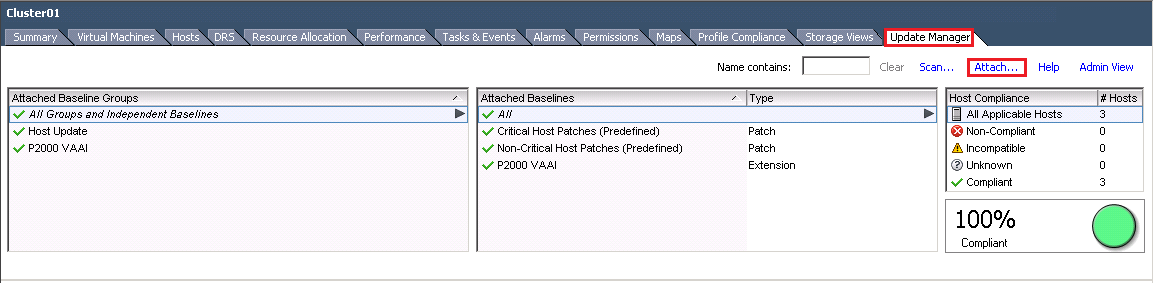
Next we are going to go the Hosts and Clusters View and select the Update Manager Tab and then select Attach

ESXi Images 6

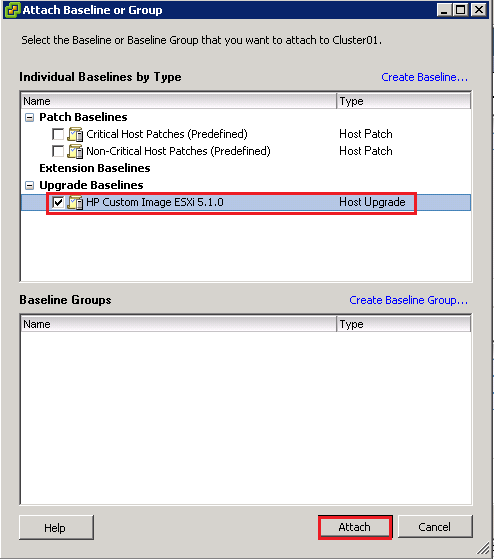
Select you Upgrade Baseline image and click Attach
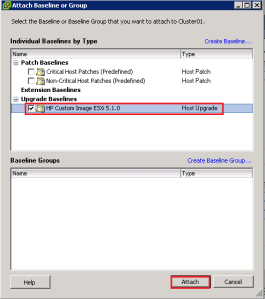
ESXi Images 7

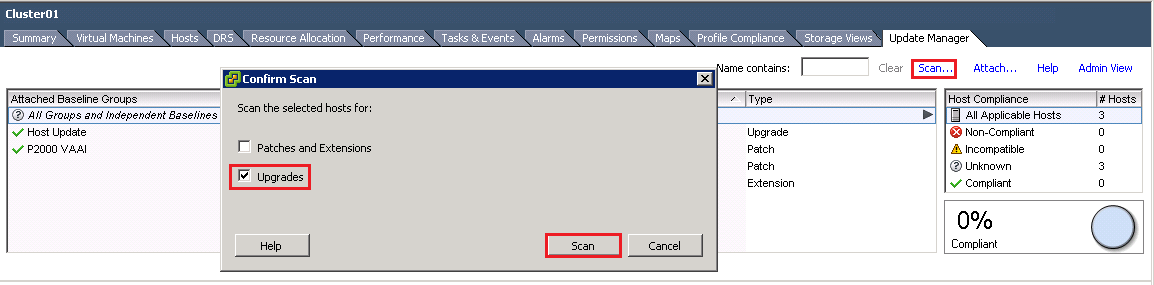
Next select Scan & choose Upgrades and then select Scan again

ESXi Images 8

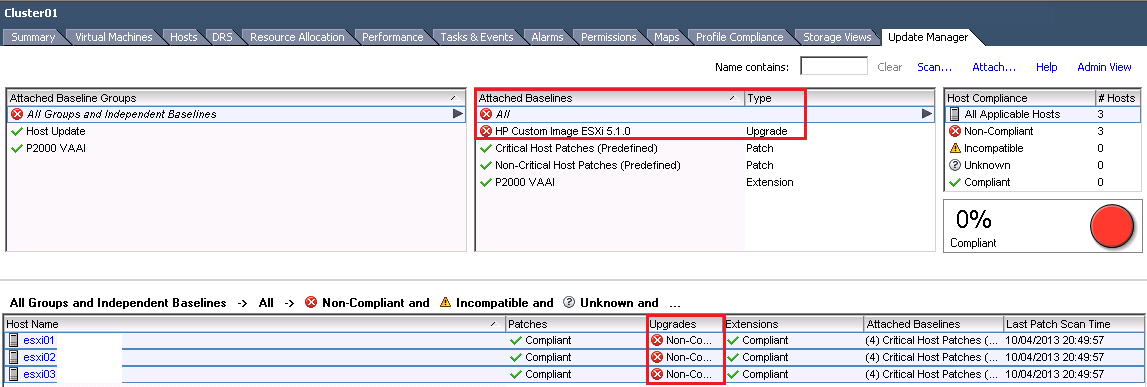
Suprisingly enough after the scan completes you will notice that your ESXi Hosts are no longer compliant
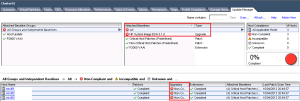
ESXi Images 9

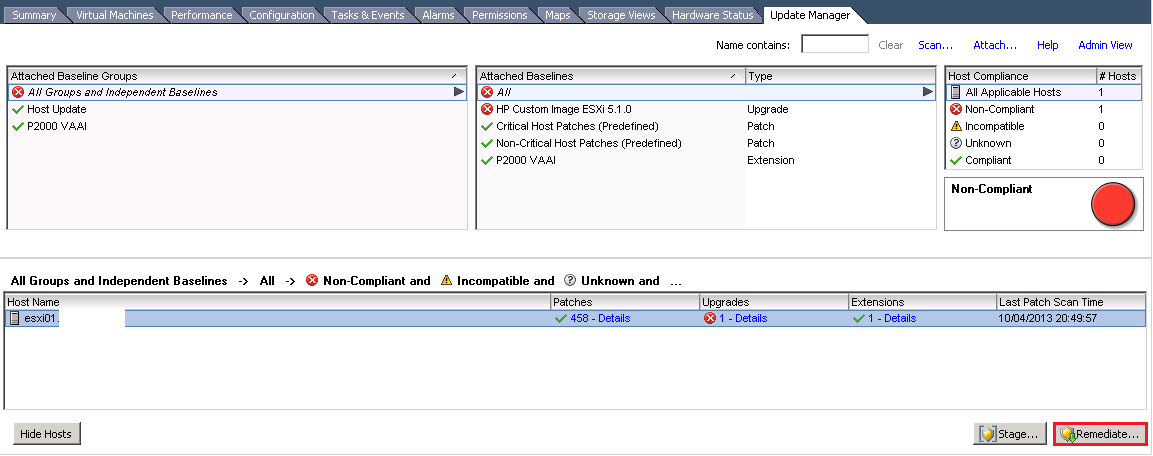
I tend to perform Baseline Upgrades on ESXi Hosts individual, rather than at Cluster level, just in case anything goes wrong.  With this in mind, go to your first ESXi Host and Select Remediate

Remediate 01

Select Upgrade Baseline and choose HP Custom Iage ESXi 5.1.0 and hit Next
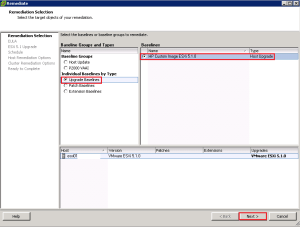
Remediate 02

Accept the EULA and hit Next

Remediate 03

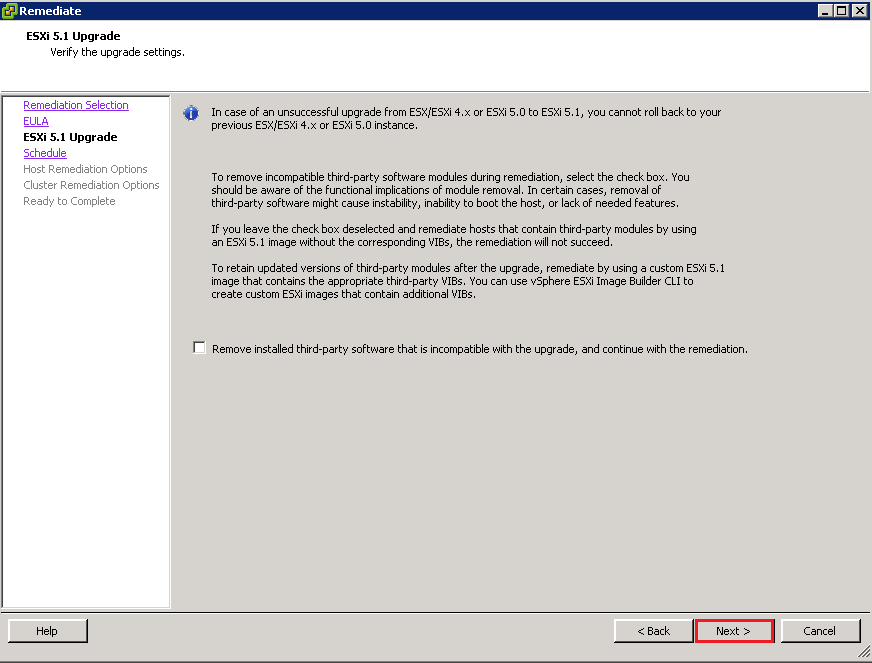
Woah, whats this message? ‘Remove installed third party software that is incompatible with the upgrade, and continue with remediation?  Word of warning you might want to check with your IT team to make sure that you aren’t going to lose any functionality.
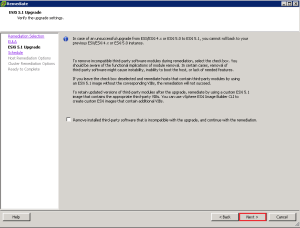
Remediate 04

Enter a Task Name & Description and hit Next
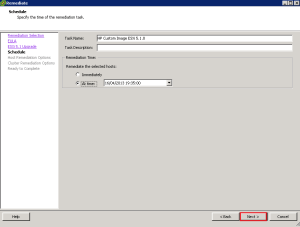
Remediate 05

On the Host Remediation Options, make sure you tick ‘Disable any removable media devices connected to the virtual machines on the host’ as we don’t want an attached ISO to be the cause of our failure.  When you are ready hit Next
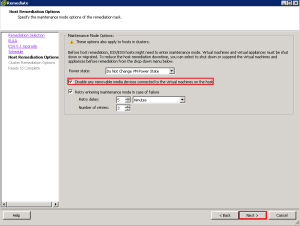
Remediate 06

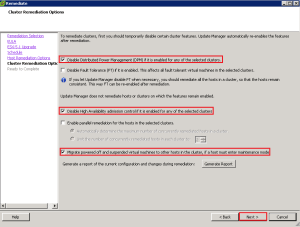
On the Cluster Remediation Options, I tend to make sure that DPM is disabled and also Admission Control so that the ESXi Host can actually be patched.  Then click Next
Remediate 07

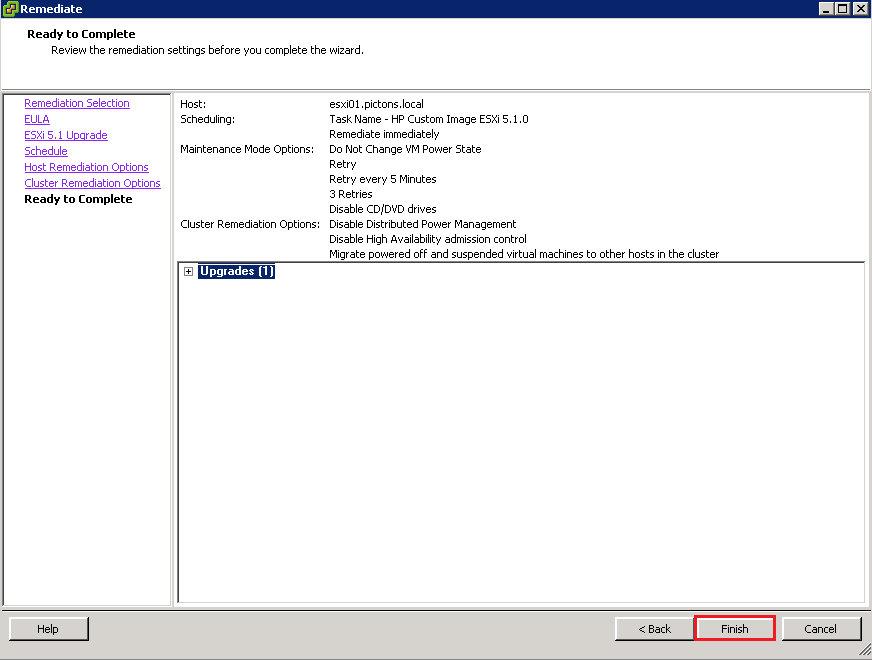
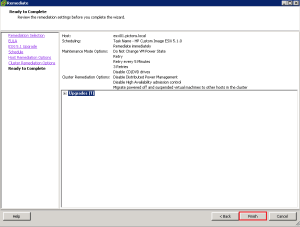
Once you are happy with your Upgrade Baseline, click Finish.  Time to go and make a brew as this is going to take along time!
Remediate 08

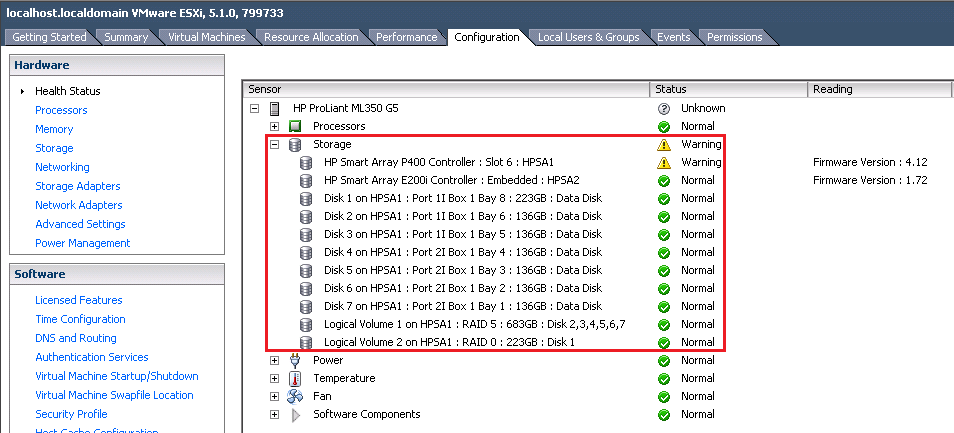
Awesome now that’s completed, we can see the Local Storage on the ESXi Host.

Storage View

Rinse and repeat for the rest of your ESXi Hosts.