Setting Up & Configuring Alarms in vCenter 5 Part 2

In the previous post setting up and configuring alarms in vCenter 5 Part 1 we looked at the initial configuration.  We are now going to run through some of the default alarms, with some suggested thresholds.

Cannot Connect To Storage why would we want to configure this? Well essentially this is a per host setting.  If the host loses connection to the storage then the VM’s will be restarted using HA.  Big deal you say, I can see that in vCentre.  Well it also manages ‘lost storage path redundancy’ and ‘degraded storage path redundancy’ so if you have an if your ESXi host has multiple connections to it’s storage, you will be notified if one of these is lost.

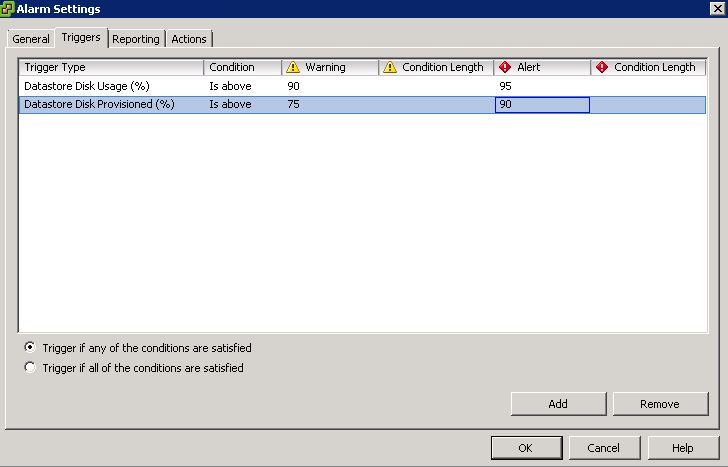
Datastore Usage On Disk quite an important one.  From the presented LUN how much space has been provisioned as a Datastore.  I recommend always asking for slightly more than need e.g. if you need 1TB for a Datastore, ask for an extra 25%.  Then when the Datastore is provisioned only use 1TB so you have room for expansion quickly and easily if needed.  With this in mind, I set the Warning to 90% and Critical to 95% so I have some room to either more VM’s around either by Storage vMotion or Cold Migration.

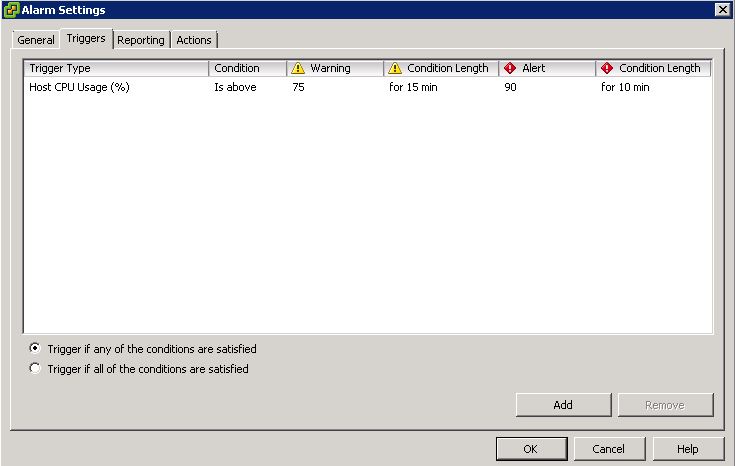
Host CPU Usage with this alarm, I generally alert at Warning 75% for 15 mins and then Critical for 10 mins.  The rational behind this is that I would want to investigate the VM’s CPU utilisation to see if it is a one off event causing the high usage or if we need to look at introducing more processing power into the cluster.
Host Error perhaps the most important one, this is what vCentre relies on to monitor host alarms!

Host Memory Usage similar to CPU usage, I generally set Warning to 90% for 15 mins and Critical for 10 mins.  Again I would want to investigate the host memory usage to ensure that we have sufficient resources for a host failure.

Host Memory Status not be confused with ‘Host Memory Usage’ this monitors the physical DIMMS.

Host Process Status again not to be confused with ‘Hot CPU Usage’ this monitor the physical processor hardware.

License Capacity Monitor I like this alarm, it’s great for items such as Site Recovery Manager or Operations Manager.  It lets you know if you are trying to protect or manage more VM’s than you are licensed for.

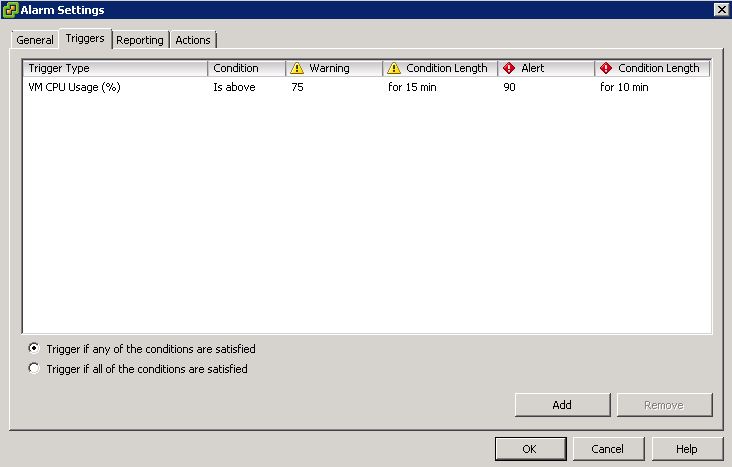
Virtual Machine CPU Usage I use the same alarms settings for ‘Host CPU Usage’ so that if a VM is using more than 75% of it’s CPU capacity for over 15 minutes, I would want to identify if this is a one off or if extra resources are required.
vSphere HA Failover In Progress this resides on the nice to have.  If for some reason none of your other alarms work then at least you know that a VM has been restarted by HA.

vSphere HA Virtual Machine Monitoring Error this alarm works in conjunction with Virtual Machine Monitoring.  I tend to leave VM Monitoring Only and Medium and then change individual VM’s monitoring to High if required.  If you have this set to high for all servers then it can cause alarms when backup software rolls back snapshots depending on how big the VM is.

Hopefully these alarms shouldn’t need any explanation, as they should ALWAYS be enabled.

Host Battery Status
Host Connection And Power State
Host Connection Failure
Host Hardware Fan Status
Host Hardware Power Status
Host Hardware System Board Status
Host Hardware Temperature Status
Insufficient vSphere HA Failover Resources
Network Connectivity Lost
Network Uplink Redundancy Degraded
Network Uplink Redundancy Lost

Naturally, this isn’t a complete list of alarms, however it is the default alarms that I would configure in most, if not all environments.  Every environment is different and you may use more or less alarms than I have mentioned.

Don’t forget that depending on which vSphere licenses you have might see extra default alarms for items such as FT.  Also when you install additional components e.g. SRM you will get even more alarms to have a play around with.

VMworld 2012 – Barcelona

I’m pretty pleased to say that I will be attending my first VMworld this year at Barcelona between 9th and 11th October 2012.

Can’t wait to check out the latest, greatest and also best practice seminars.  Plus spend some time meeting fellow VMware enthuasiasts.

Hopefully, I should get some time this week to sit down and use the VMworld Schedule Builder

A particular area of interest for me is vCloud Director, I haven’t used this product before, however it is something that I’m really keen to understand and progress onto the VCP-IaaS (Infrastructure as a Service).

Look forward to seeing you there 🙂

How Do I Get VMware vSphere Licenses For My Home Lab/Test Environment?

I was talking to several colleagues recently who mentioned it was a real pain having to rebuild his home lab vCentre environment every sixty days.

They did not know that VMware offer NFR (not for resale) licenses, which are available if the company you work for is a VMware Partner.

VMware provides partners with access to a number of VMware software products to enable a successful VMware virtualization practice. Not for Resale (NFR) software is available to partners for product demonstration and training purposes only. One year of subscription services is included with NFR software as long as the partner remains in good standing within the parameters of the VMware Partner Program.

How Does My Company Receive NFR?

NFR licenses are automatically delivered by VMware to the headquarter location upon membership progression (such as Registered to Professional or Professional to Enterprise) and release of new products. Licenses that are provided as part of the NFR offering are delivered to the License Administrator via ESD (Electronic Software Distribution) or to the primary contact if a license administrator has not been identified

Before we move on, a little disclaimer, I don’t know what criteria VMware use to accept or validate requests for NFR licenses, nor do I know any hacks or cracks to gain free VMware licenses.

To put forward a case for NFR licenses you have to register for VMware Partner Central by entering the company you work for and having these details validated by a representative from your company.

Once logged into VMware Partner Central, select ‘Partner University’ from the top menu bar

From the left hand side select ‘Contact Us’
On the right hand side select ‘Submit a Case Now’
Under Reason select Question/Inquiry
Under Issue Category select Benefit / Entitlement
Under Issue Type select Not for Resale Licenses (NFR)
You will need to enter a subject and explain the reasons/business case for the request for any extra NFR licenses.

My experience submitting cases via Partner Central has been extremely positive, normally you receive a response within 24 hours and an answer within 48 hours.

Setting Up & Configuring Alarms in vCenter 5 Part 1

vCenter has some great inbuilt alarms which can trigger alerts via email or SNMP to the IT administrator   I have seen quite a few environments, where alarms haven’t been configured!  The obvious question is, is this due to lack of knowledge or do the administrators really check every item manually within vSphere? My guess is the earlier.

With this in mind, I thought I would go over the basic settings and then also what alarms/alerts I generally put in place along with some rational over the triggers.

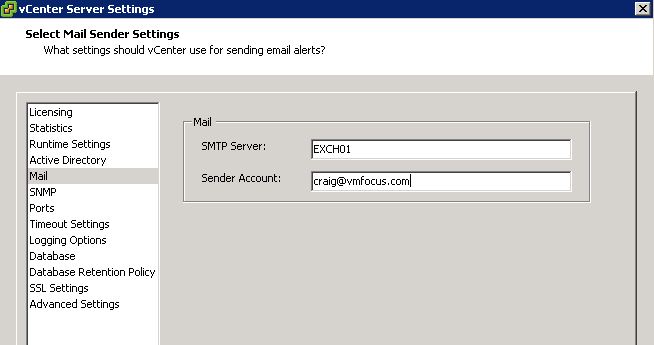
The first thing we have to do is configure vCentre to send out email and SNMP alerts.  Go to Home > vCenter Servers Settings or to Top Menu Bar > Administration > vCenter Server Settings

Select Mail from the left hand side and enter your SMTP Server details.  Note that VMware does not support email authentication, so if you are using an Exchange 2003/2007/2010 I recommend you create a new receive connector called ‘vmware’.

Select SNMP from the left hand side and enter either the IP Address or DNS Name of your SNMP Server along with the community string needed to validate if any different from ‘public’

If you need the MIBS (Management Information Base) these can found at %ProgramFiles%VMwareInfrastructureVirtualCenter ServerMIBS if the default installation path has been used.

Alarms can be configured at a few different levels which are:

Root these alarms will encompass Datacentre, Cluster, ESXi Hosts, Resource Pools and VM’s

Datacentre these alarms will encompass Cluster, ESXi Hosts, Resource Pools and VM’s

Cluster these alarms will encompass ESXi Hosts, Resource Pools and VM’s

ESXi Hosts these alarms will encompass Resource Pools and VM’s

Resouce Pools these alarms will encompass the VM’s that reside within them.

VM these alarms are only specific to the virtual machine

Generally speaking, nearly all the alarms which I create are done at the root level which means that whatever actions are performed by the vCentre administrator, they should be covered.

vCentre allows you to configure actions for alarms based around set criteria.  When the alarm is triggered it can be configured to alert once or repeat

When the alarm triggers, it will do so when it enters a warning state e.g. Datastore Disk Usage Is Above 90% and then again when it hits a critical state e.g. Datastore Disk Usage Is Above 95%

So following this through, alarms can be triggered by the following events:

Normal Condition > Warning Condition
Warning Condition > Critical Condition
Critical Condition > Warning Condition
Warning Condition > Normal Condition

Alarms can be triggered if they meet ‘any’ of the conditions or ‘all’ the conditions you have set.

If you are a savy VMware Administrator you may ask the storage team for a 2TB LUN, but you only really need 1TB. So you provision a datastore at 50% capacity so you want to create a warning alarm when it reaches 75% provisioned and then critical at 90% provisioned, so you know when to ask for some extra space from the storage team.

With this in mind, imagine you had a single alarm which covered both Datastore Disk Usage (%) and Datastore Disk Provisioned (%).  However, I would always recommend using ‘trigger if any of the conditions are satisfied  unless you have a compelling reason not to do so.

So now we have configured vCenter to be able to send alerts, we need to configure some for it too send!  Hold fire until Part 2.

Backing Up vCentre Using Veeam 6.1

Veeam is a great product, I use it regularly to meet customers RTO (Restore Time Objectives) and RPO (Restore Point Objectives).  As I’m sure you know Veeam’s functionality is extremely diverse with DR, CDP and Backup capabilities.

One of the issues we have had with Veeam has been when you are backing up a virtual vCentre or SQL server that is responsible for the vCentre database.  Essentially what happens is that Veeam sends a ‘snapshot’ command to vCentre for creation of a VSS snapshot, but then cannot communicate with vCentre as it’s database is frozen.

To get around this issue you would add the ESXi host that held vCentre and your SQL database manually meaning that Veeam would communicate with the ESXi host directly and your backup would complete.

This caused issues where if you had DRS enabled and your vCentre or SQL moved your backups would fail.  So more often than not you would have to tie vCentre or SQL to a particular host which kind of defeated the purpose of HA.

So, whats changed, well in our environment, we recently upgraded to Veeam 6.1 with the following configuration.

Veeam Backup & Replication Enterprise v6.1

Veeam is a virtual server with 8 vCPU’s broken down into 2 virtual sockets and 4 cores per socket with 12GB of RAM

vCentre Server Standard v5.0.1

vCentre Server is again a virtual server with 2vCPU’s and 4GB RAM.

This has SQL 2008 R2 Standard installed locally holding the following databases:

– vCentre
– VMware Site Recovery Manager
– VMware Update Manager

SQL 2008 R2 Enterprise

SQL is a virtual machine and holds four instances.  A single instance contains the databases for:

– Veeam

Now you have an overview of the environment, lets create a couple of fresh Veeam jobs.

Backup Job 1 – vCentre

This contains vCentre directly added via the vSphere 5 Cluster, with Proxy Selection ‘Automatic’ and Advanced Settings left as default.

To avoid any confusion, ‘The Backup Proxy’ is this server.

Enable application-aware image processing is NOT selected.

Result is a success.

So what does this mean?  Well we don’t have ‘enable application-aware image processing’ selected.  This means that your SQL database might not be transactionally consistent which could result in data loss and that Veeam does not commit the transaction logs.  However, this can be overcome by creating a SQL maintenance plan, not elegant, but effective!

So essentially, the choice is yours, keep vCentre physical or tie vCentre to a particular ESXi host.  Both mean that vCentre isn’t protected by high availability.  Or do what I have explained and have to use a SQL maintenance plan.

For more information on Veeam Backup & Replication 6.1 please visit Veeam ESX Backup