ESXi Networking Part 2

VMkernel Ports

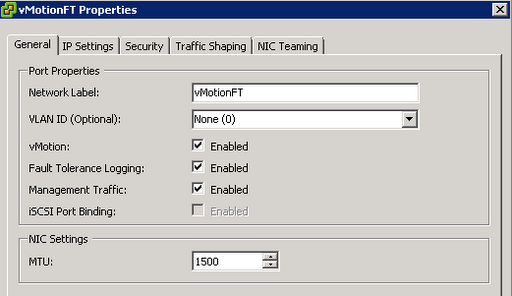
I mentioned in ESXi Networking Part 1 that the VMkernel network carries traffic for:

– vMotion
– iSCSI
– NFS
– Fault Tolerance Logging

VMkernel ports require an IP address, you can have more than one VMkernel network if you feel this level of redundancy is appropriate in your network.  Or you could have one VMkernel network for Management Traffic, Fault Tolerance Logging and vMotion (however I would recommend against this).
VM Ports

Virtual Machine port groups are quite different to VMKernel Ports as they do not require an IP address or an uplink (physical NIC) to work.  They work in exactly the same was an unmanaged physical switch, you plug it in and off you go!

VLAN

Using VLAN’s within ESXi generally is a must unless you have an abundance of physical NIC’s (the limit is 32 per ESXi Host).  VLAN’s provide secure traffic segmentation and reduce broadcast traffic across networks.

We can have multiple Port Groups per uplink if required.  When configuring VLAN’s these can be performed in one of three ways:

– VM Port Group, when adding a new port group you can specify the VLAN ID in the properties of the port group (most common).

– Physical Switch, you can ‘untag’ the uplink that the VM Port Group resides on which forces it into the VLAN ID specified on the physical switch (common).

– Virtual Guest Tagging, this is when the virtual machine is responsible for VLAN tagging.  From an ESXi perspective you need to use VLAN ID 4095 (uncommon).

The uplink that is connected to the physical switch must be configured as a ‘trunk port’ to enable the switch port to carry traffic from multiple VLAN’s at the same time.

Below is an example Standard vSwitch0, from my home LAB, this has one uplink and has three different VLAN’s in play.

VLAN  1 which is the default VLAN and is used by the VMKernel for Management Network purposes and also my Server2012 RC.

VLAN 2 holds my nested ESXi Hosts and vCentre Virtual Appliance.

VLAN 3 holds my iSCSI Storage Area Networks.

NIC Teaming

NIC teaming is used to connect multiple uplinks to a single vSwitch commonly for redundancy and load balancing purposes.

I have seen many NIC teams created with no thought for redundancy on the network card.

Incorrect NIC Teaming

In this configuration we have no resilience for network card failure.
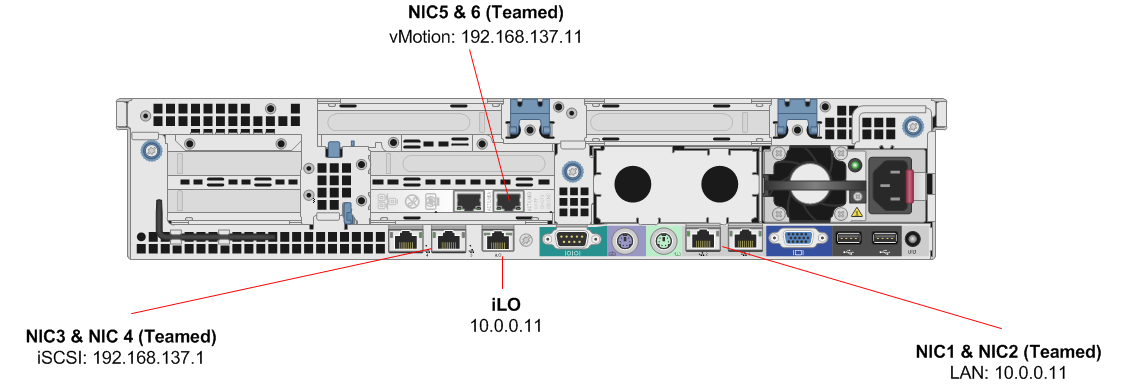
Correct NIC Teaming

In this configuration we have resilience for network card failure.

ESXi Networking Part 1

One of the items that becomes apparent when using VMware is that you need to have a strong understanding of routing and switching.

This blog post is a bit self indulgent as I’m preparing for the VCP 5 exam, I thought it would be good for me to put together a few posts on the achitecture of the switches.

All of the switches within ESXi are software based and operate within the VMkernel.  They are called virtual switches (vSwitches) and are Layer 2 devices, which are capable of trunking and passing VLAN traffic.  A common myth is that vSwitches can trunk ports together using 802.1q. vSwitches do not use Spanning Tree Protocol as one vSwitch cannot be connected to another vSwitch.

Standard Switch (vSwitch)

These are created when we first install ESXi onto our server hardware.  By default this is called vSwitch0 and contains 120 visible Ports (actually holds 128 Ports, 8 are reserverd by the VMkernel), the first virtual machine ‘port group’ called VMNetwork and a Management Network which is used by the VMKernel.

Distributed Switch (dvSwitch)

These are standard switches which are logically grouped across all ESXi hosts who share a common distributed switch configuration. These are only available with Enterprise Plus licenses.

Port Groups

These reside within a vSwitch.  Port groups contain two different configurations:

– VMkernal Ports allow vMotion, Fault Tolerant Logging, iSCSI NAS, NFS traffic between ESXi hosts as well as allowing management of the ESXi host it resides on.

– VM Ports allow a virtual machines to access other virtual machines or network based resources.

The key thing to remember is that with Port Groups they must be named exactly the same across all ESXi hosts to allow traffic to flow.

Note, it is possible to have a vSwitch without any Port Groups, however this would be like having a physical switch without any physical ports!

Uplinks (pNIC)

An uplink if the physical network adapter that the vSwitch is connected too.  Without this the virtual machines that reside on the vSwitch would be isolated and unable to communicate with the rest of the network.

In the picture below we have a Standard Switch called vSwitch1 whose physical uplink (pNIC) is vmnic4.  It contains two different port groups, one for vMotion and Fault Tolerant Logging and the other for VM’s on VLAN29.

Even though we have two different port groups, it is important to remember that each port group is a boundary for communications, broadcasts and security policys.

Debunking the Myths of Virtualizing Your Business Critical Applications

They say fear is good.

Fear can be a healthy thing—it can keep you from getting in over your head, taking unnecessary risks, and it can even save your life. In IT, that fear—maybe better framed as ‘caution’—has its place. It ensures that we consult with others, adhere to processes and standards, and balance risk with reward. Caution in IT ensures that business keeps moving forward—because if it doesn’t, revenue is at risk (and necks are on the line). So, we proceed with caution.

In the world of virtualization, there is fear—but, for the most part, it’s misplaced. Many companies that have fully embraced the benefits of virtualization are still missing the greatest value because they think it’s too risky to virtualize business critical applications (BCAs).

Read more here

ESXi 5 Host Isolation

What is a ‘host isolation’?

It’s the term that VMware use to define when an ESXi host is no longer able to communicate with specific IP address’s and therefore it is deemed to be isolated from the rest of the cluster.

By default the ESXi hosts default gateway (the VMkernal gateway) is used.  Depending on your infrastructure this is normally a Layer 3 switch, router or firewall.

Whats the problem with that you ask? Well what happens if you have an outage of your Layer 3 switch, firewall or router? Well vCentre will think that your ESXi hosts are isolated and depending on your ‘host isolation response’ perform one of the following actions:

The recommended action for vCentre 5 is to ‘leave powered on’.

We therefore need to provide more external devices for vCentre to communicate with before it invokes a host isolation response. To do this we go into the Cluster Settings > vSphere HA > Advanced Options.

We then add additional IP address’s that we went vCentre to communicate with in the following format:

das.isolationaddress1 10.0.0.1
das.isolationaddress2 192.168.1.1

We then end the range of IP address’s with ‘das.usedefaultisolationaddress’ ‘false’

What IP address’s would I recommend you use in a production environment?

– vMotion/FT switches
– SAN Controller Management IP address’s
– Layer 2 Switch
– Layer 3 Switch
– Firewall

Virtual Machine Notes

It’s happens to the best of us, we go to a client site to check/review the current infrastrucutre and we get greeted with zero documentation apart from it being in ‘Dave the IT guys head’.

‘Dave the IT guy’ is then on annual leave or ill so we start a manual process of trying to discover an account with enough privileges to let us login to servers and eventually find out which server holds the vCentre role.

Great, we then get greeted with the old IT favourite, servers named after items from Star Wars!  The usual suspects are there, R2D2, C3PO, DarthVader, LukeSkywalker, Endor etc.

This leads me onto Virtual Machine notes, something which all of us have been guilty of over looking.  It’s such a simple thing that makes every discovery process or day to day administration so much easier.

Spend a few minutes per server to make a quick note about what roles they perform and it makes everyones life easier.

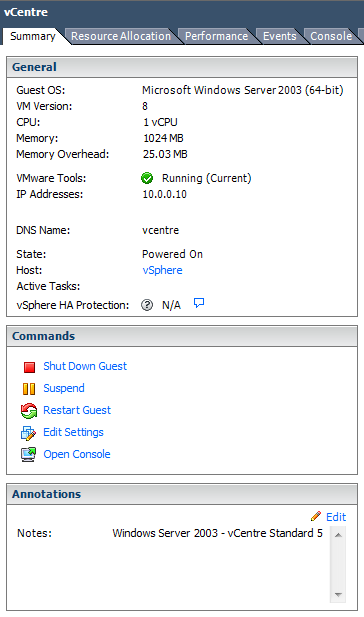
We only need to click the Virtual Machine and then add a note.