HP P2000 G3 Firmware Upgrade

The HP P2000 G3 is HP’s entry level SAN, it’s a robost piece of kit, as long as you keep the firmware updated.

Before we upgrade the SAN firmware, let’s run through a couple of items.

  1. Brick – It might happen, the SAN could become a brick after the firmware upgrade, always get a good backup of your data before you embark on the firmware upgrade.
  2. Downtime – Even though this can be done live, I recommend you arrange downtime, it’s just the sensible thing to do and gives you flexibility.
  3. Internet – This should go without saying, as you need to be able to download the drivers.
  4. Alarms/Monitoring – Turn this off for the SAN, as you will be inundated with emails/tickets.

Right then let’s crack on shall we.

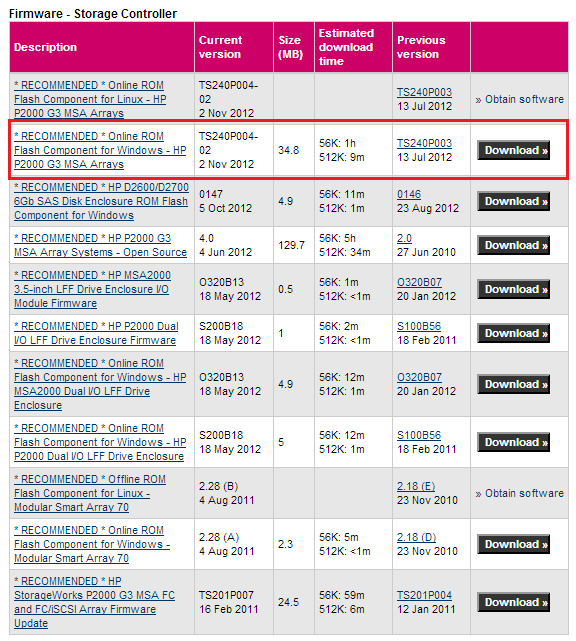
First of all we need to download the right firmware at the time of writing this the TS240P003 has been released, this can be obtained from here

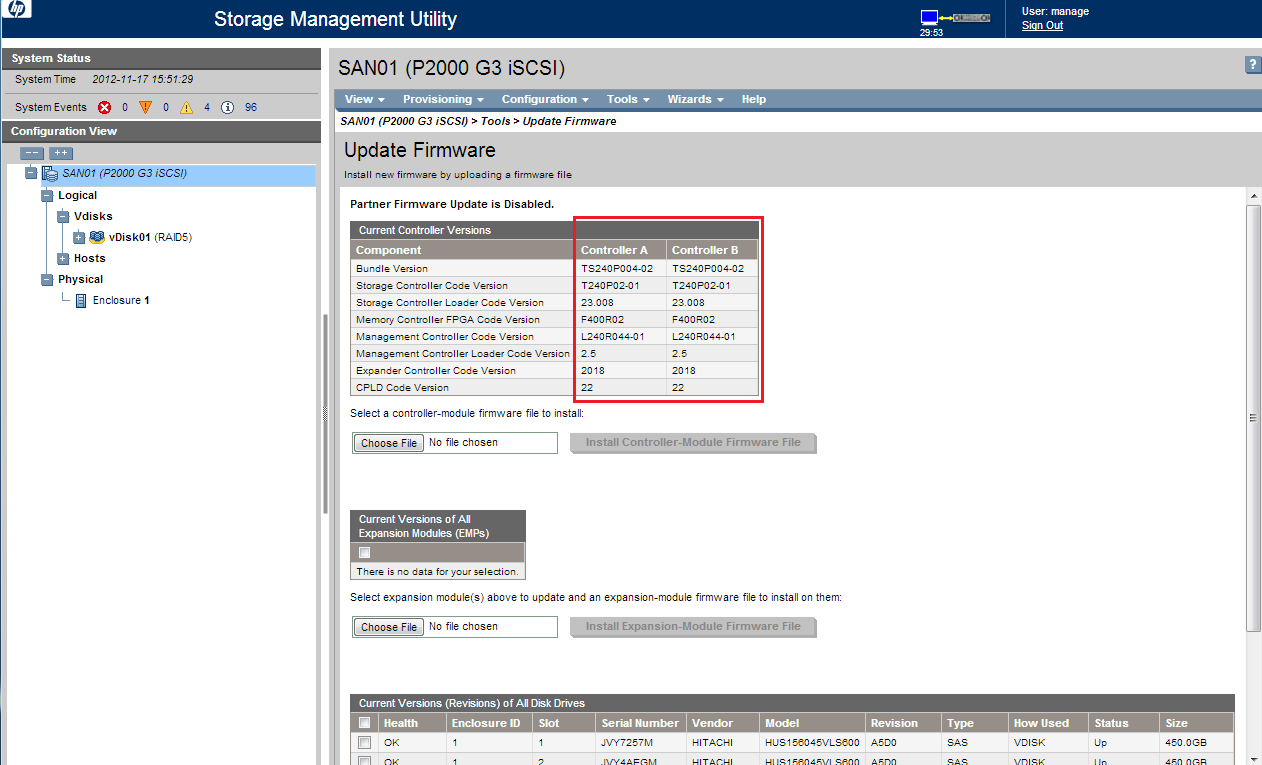
To make things slightly easier the one you want is in the red box below,.

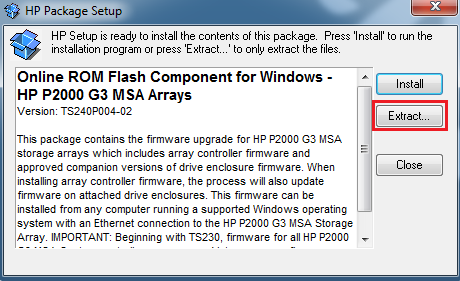
After you have downloaded the firmware, we need to extract it, you can try the online flash, but for me it never works.

The file we care about is TS240P004-02.bin

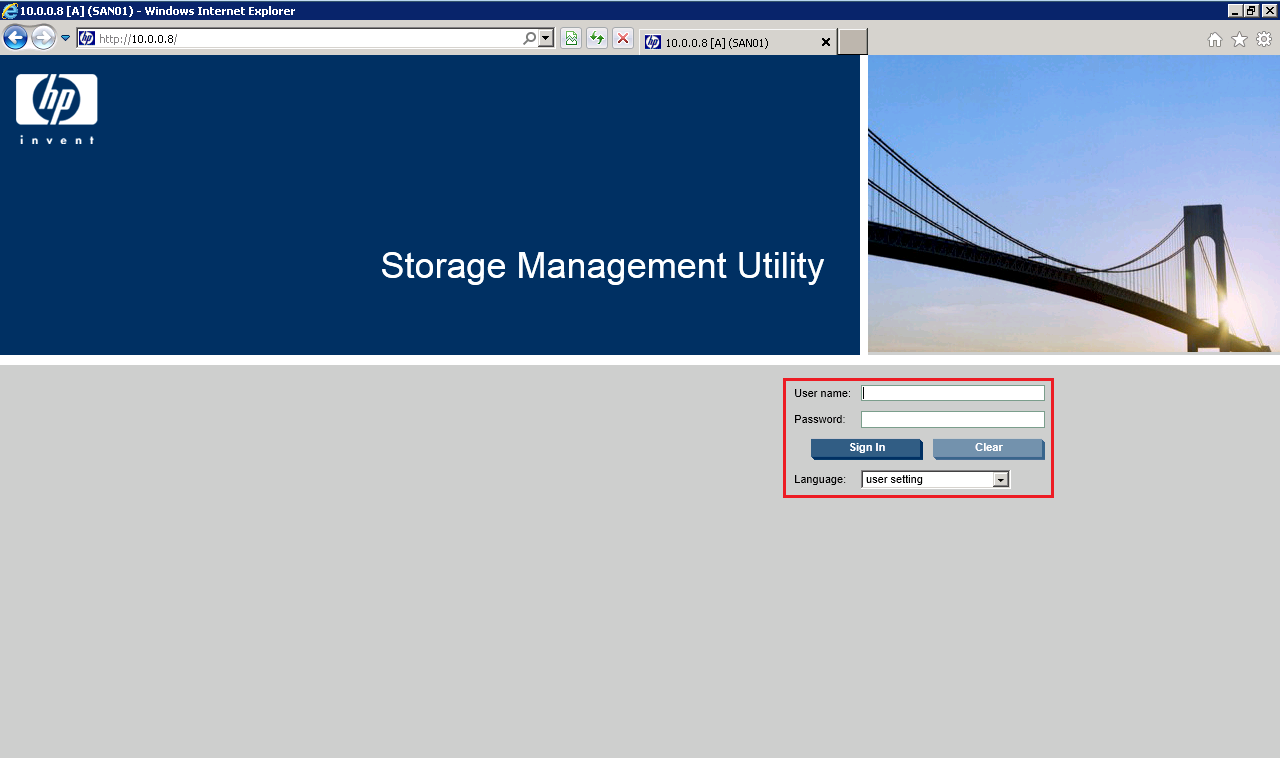
Log into your P2000 G3 by browsing to the IP Address of either Management Controller

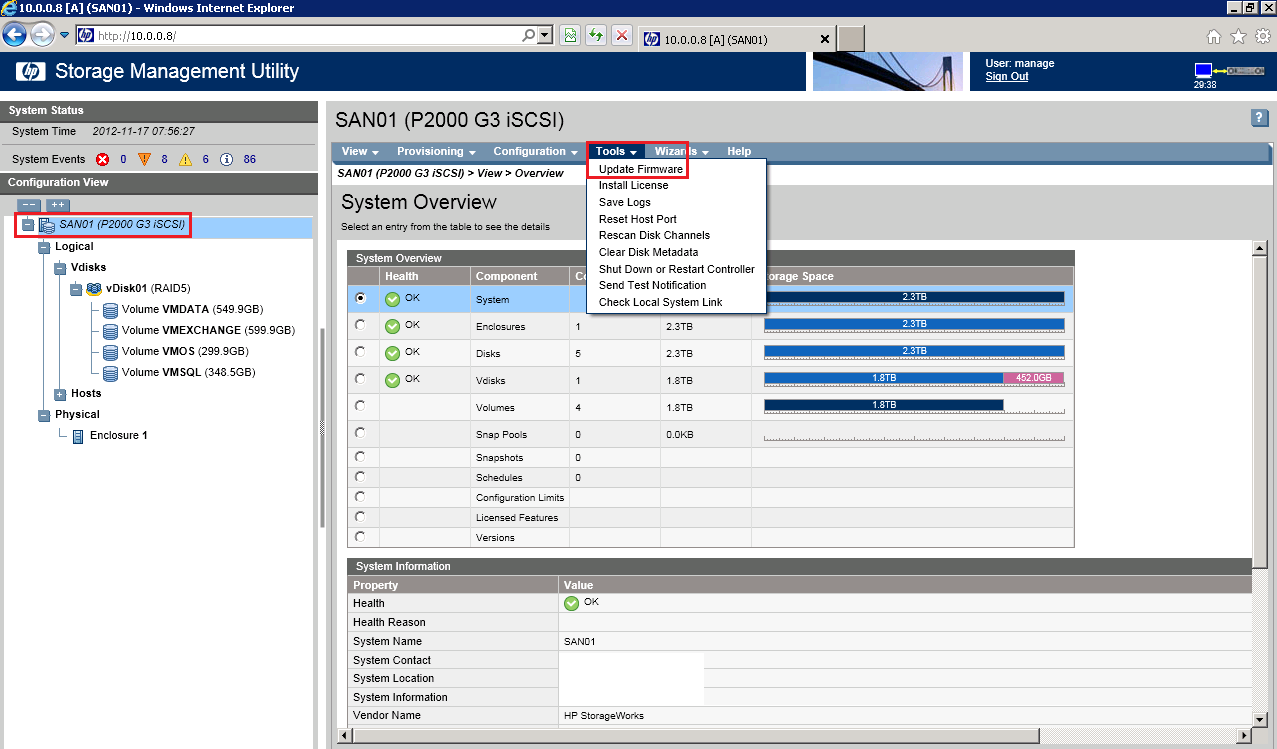
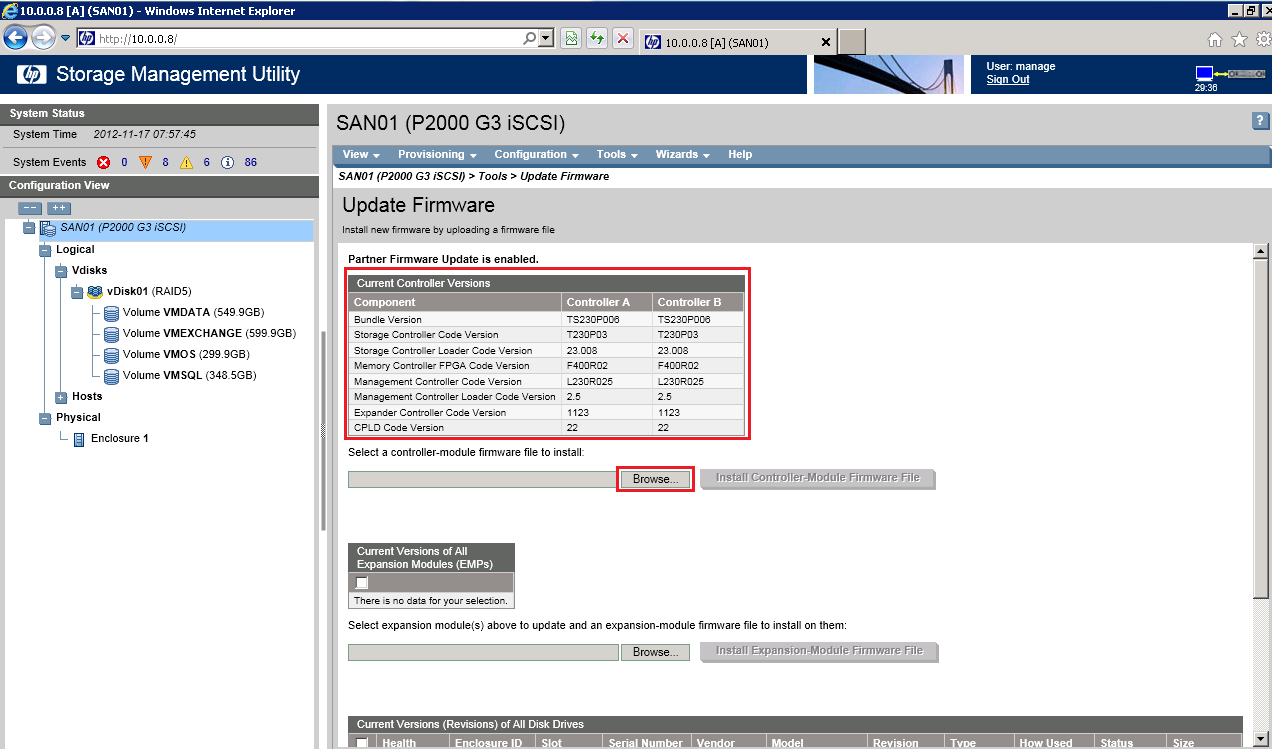
Select the SAN name on the top left level and go to Tools > Update Firmware

At this point, I would double check that you have an straight upgrade path from your current contoller firmware to the one you intend to install.  I have checked mine so we are golden.

Click Browse to locate the TS240P004-02.bin file

TOP TIP: The controller you are logged into is the controller you will be upgrading the firmware on.

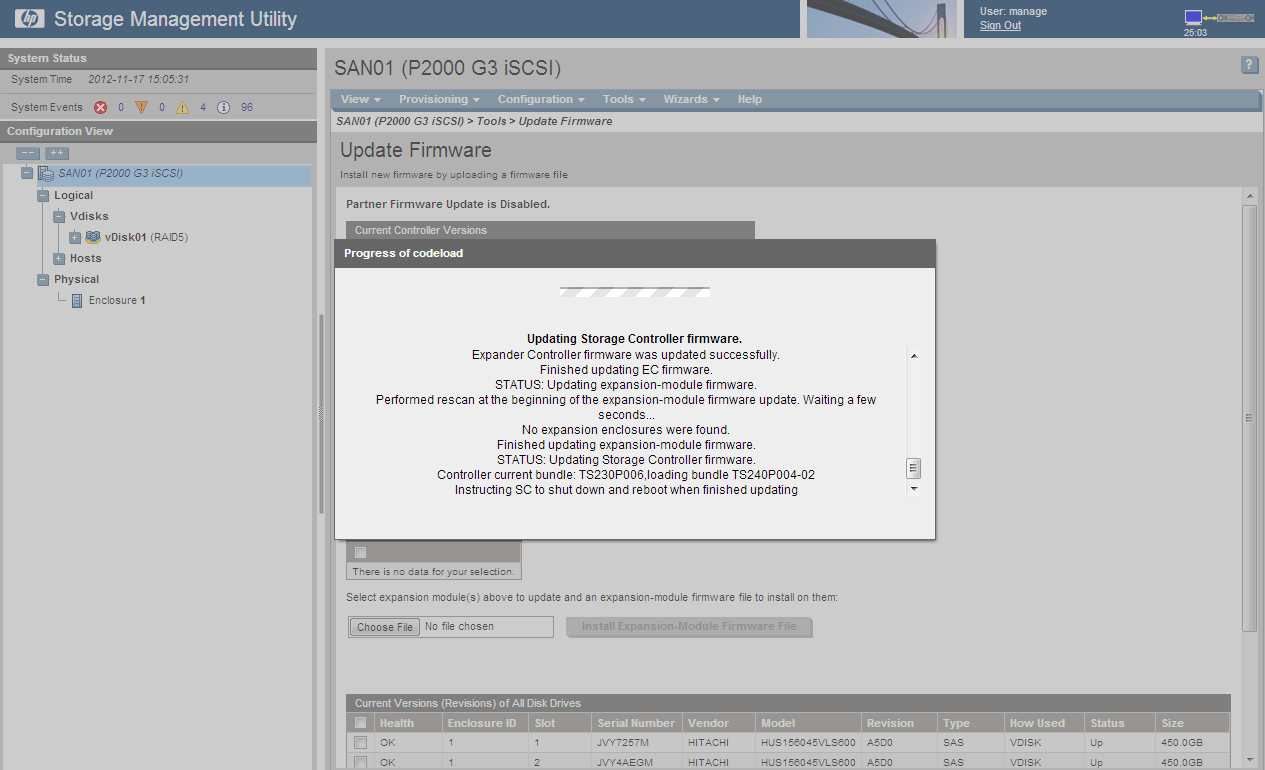
Click on OK and you will see the firmware being uploaded and applied, this can take some time so don’t worry.

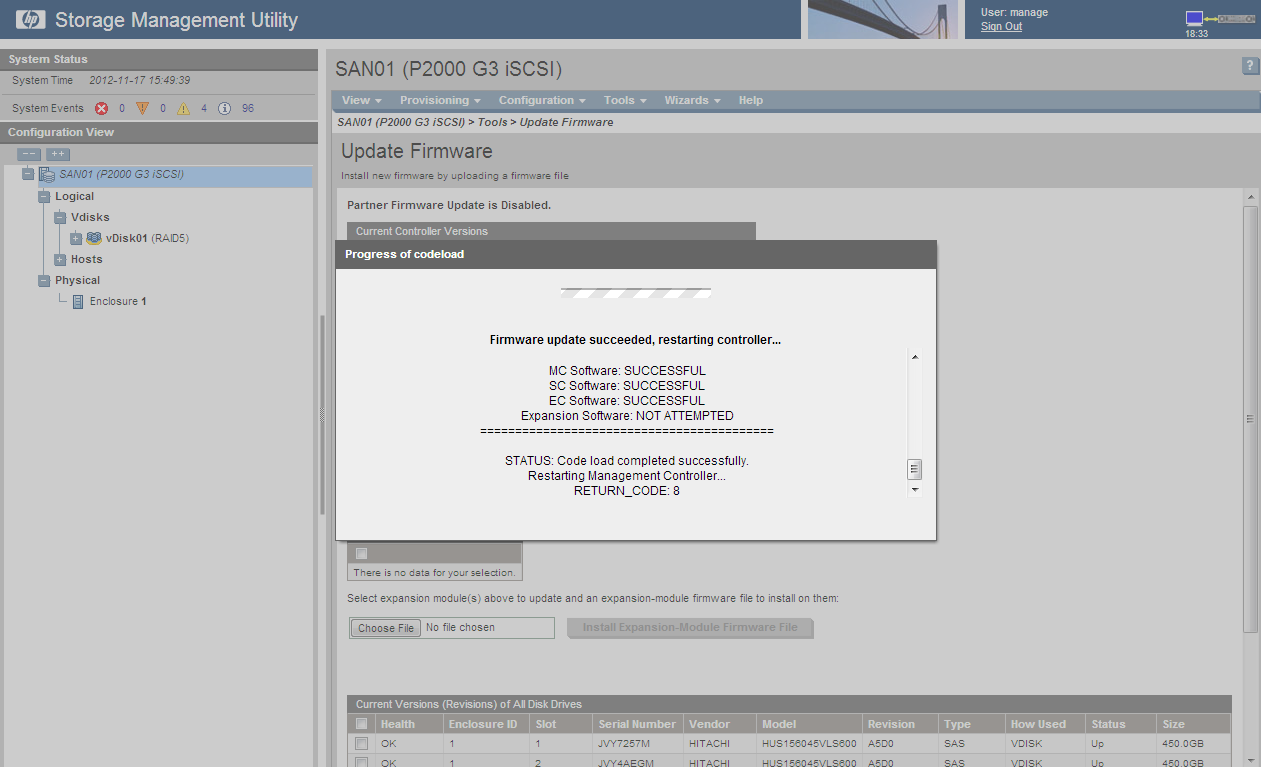
Boom, it’s finished you should receive a ‘firmware update succeeded, restarting controller’

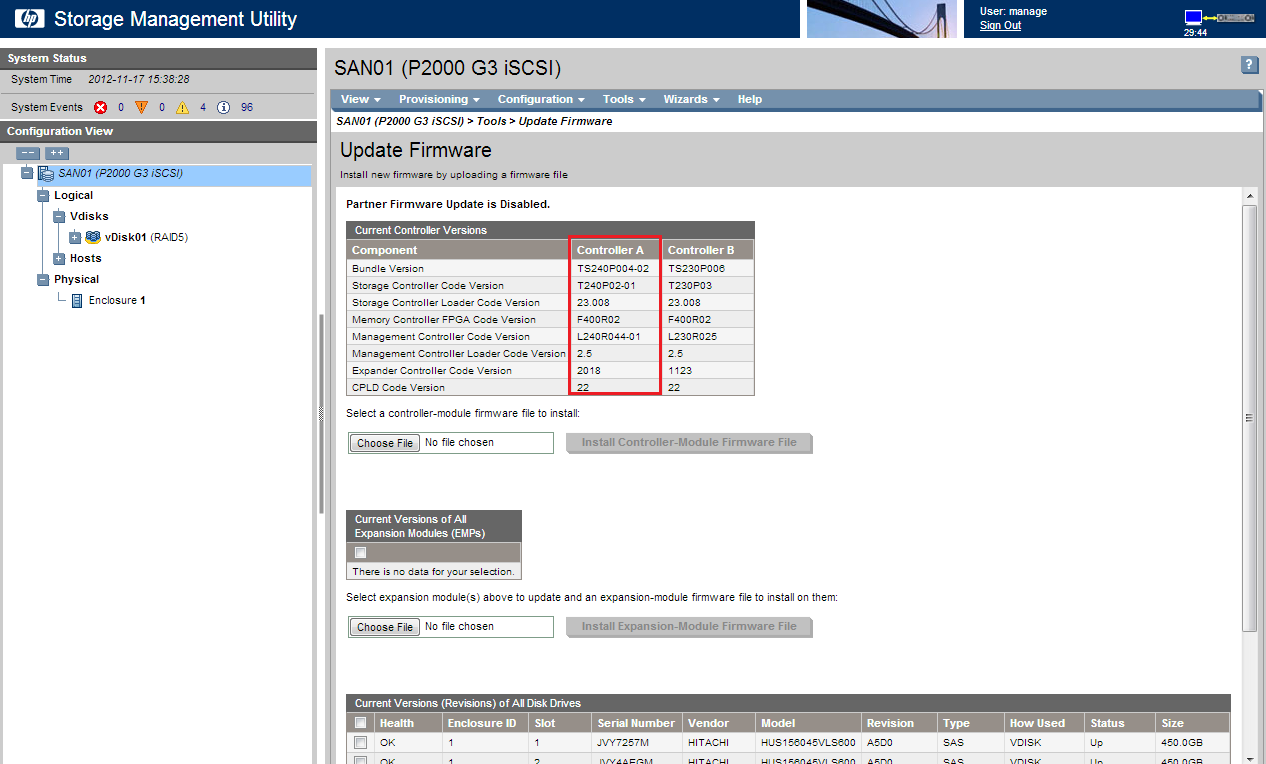
At this point you should have different versions of firmware on your controllers

TOP TIP: Check iSCSI or Fibre Channel access to your Volumes before you move onto the next controller.

Rinse and repeat for the next controller, and you should be golden.

Part 5 – Configuring Site Recovery Manager (SRM) With HP StoreVirtual VSA

This is the final post on my blog series Configuring Site Recovery Manager (SRM) with HP StoreVirtual VSA.

If you have missed any of the previous posts, they are available here:

Part 1 – Configuring Site Recovery Manager (SRM) With HP StoreVirtual VSA

Part 2 – Configuring Site Recovery Manager (SRM) With HP StoreVirtual VSA

Part 3 – Configuring Site Recovery Manager (SRM) With HP StoreVirtual VSA

Part 4 – Configuring Site Recovery Manager (SRM) With HP StoreVirtual VSA

As promised we are going to failover, reprotect and failback. Is it slightly wrong, that I’m excited about this blog post?

Pre Failover

As we are good boy/girl scouts, we wouldn’t just jump straight in and try and failover would we? No, never instead we are going to check everything is ‘tickety boo’ with our environment.  This means going over the following checklist:

  • Check CMC to ensure no degraded volumes
  • Check CMC to ensure that remote copy is working correctly
  • Check vCenter to ensure that you have connectivity between sites
  • Check SRM Array Managers and refersh your Devices
  • Check Protection Groups
  • Check Recovery Plan

Once you have gone over the above list, the last thing to do is test and clean up.
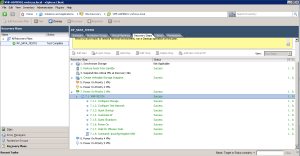
Look’s like we are cooking on gas.

Failover

We have two types of failover, planned and unplanned.

Planned Failover is when you know of impending works which will make your Production site non operable for a period of time, this could be planned  maintenance work or site relocation.  Imagine you are building a new Head Office, you configure all of your network, storage and vSphere infrastructure and then just use SRM to failover over a weekend.

Unplanned Failover this is when, you earn your ‘bacon’ as a vSphere Administrator, as you have a man down situation and no Production site left.

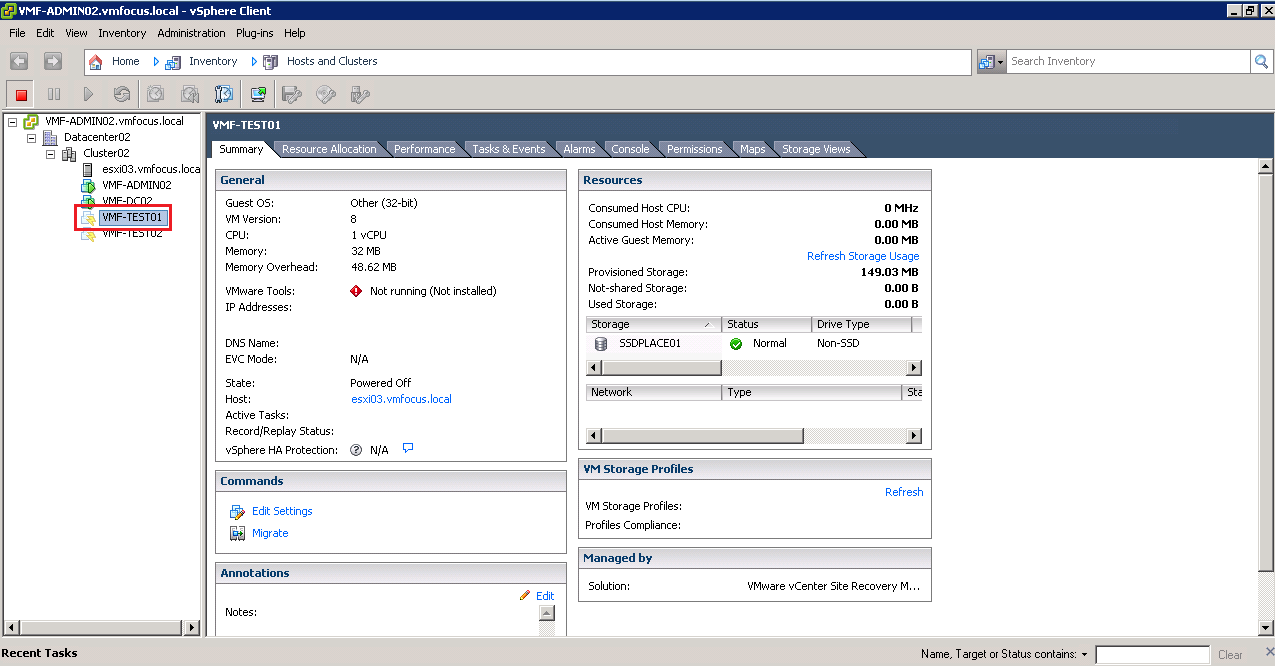
In this instance we are going to do a planned failover, as you can see VMF-TEST01 is running in our Production site.
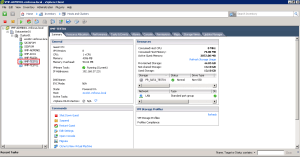
VMF-TEST01 is in a good place, as it’s being replicated to our DR site
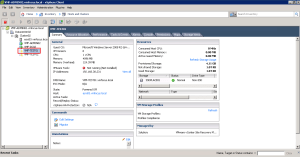
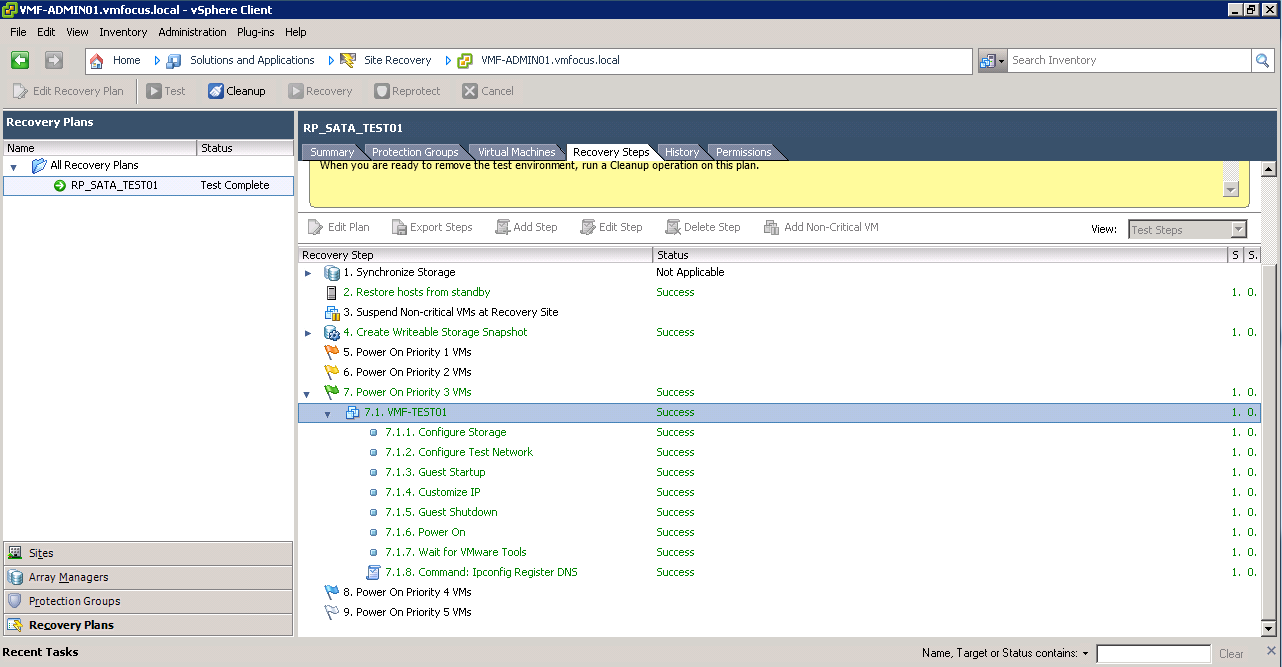
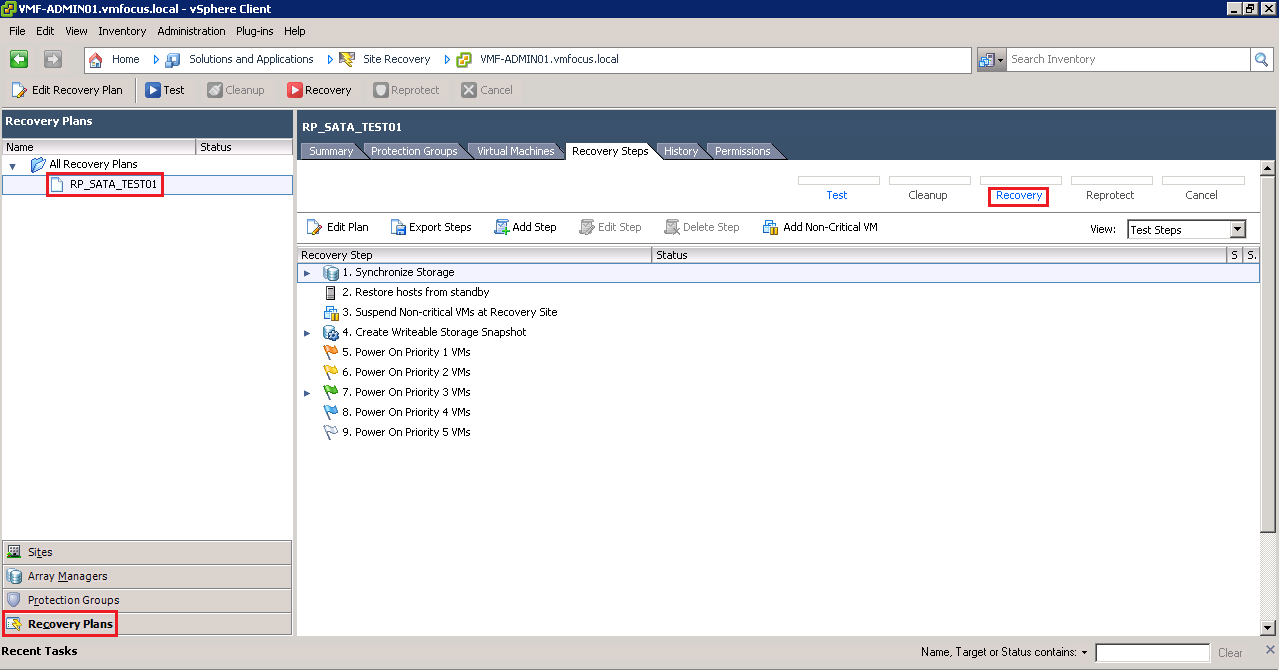
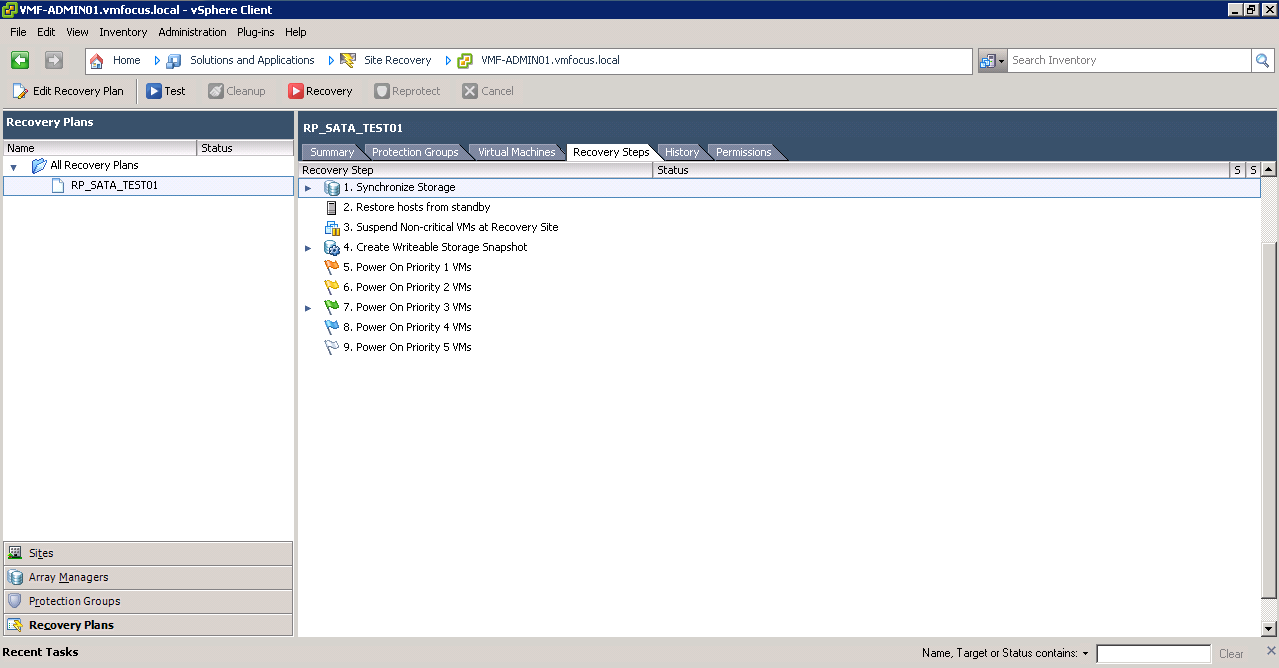
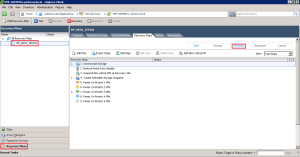
Let’s get it on, into SRM, then click on Recovery Plans, then onto Recovery Steps (so that we can see what’s going on) and then click on Recovery!
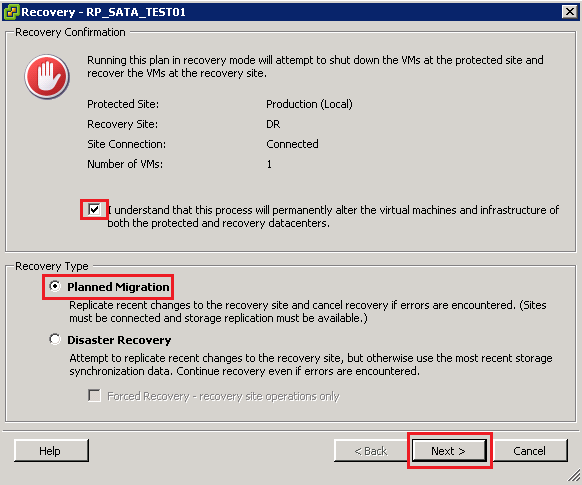
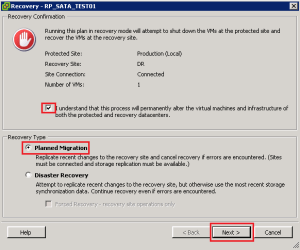
The Red Stop Sign cracks me up, it’s SRM’s way of saying are you really sure you want to do this? We are sure, so we want to put a tick in the ‘I understand that this process will permanently alter the virtual machines and infrastructure of both the protected and recovery datacenters.’

We are going to perform a ‘Planned Migration’ and then click Next
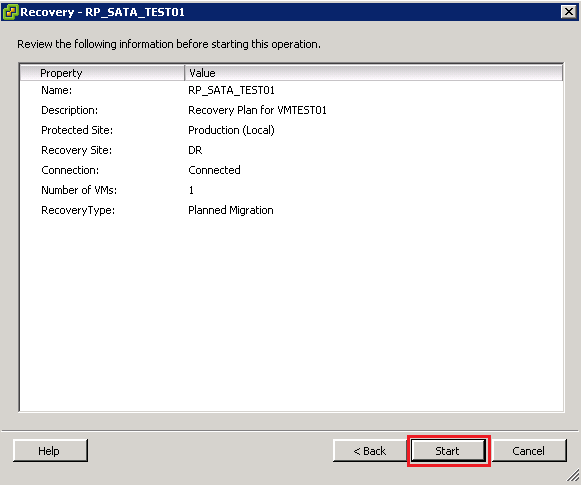
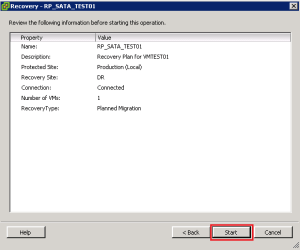
We are now at the point of no return, click Start
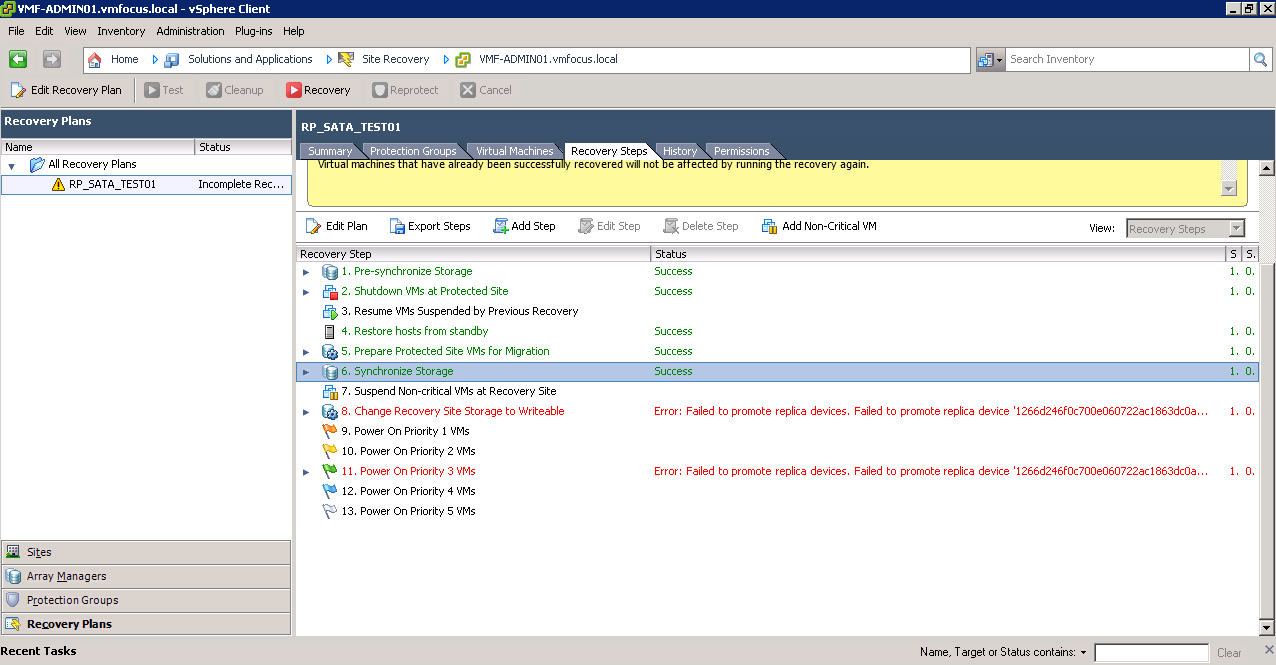
OK, what’s going on? Well the let’s have a closer look.

Step 1 SRM takes a snapshot of the replicated volume PR_SATA_TEST01 before it tries to failover, this is for safety.

Step 2 SRM shuts down the VM’s at Protected Site, in this case VMF-TEST01 to avoid any data loss

Step 3 SRM restores any hosts from standby at the DR Site

Step 4 SRM takes another snapshot and syncronizes the storage

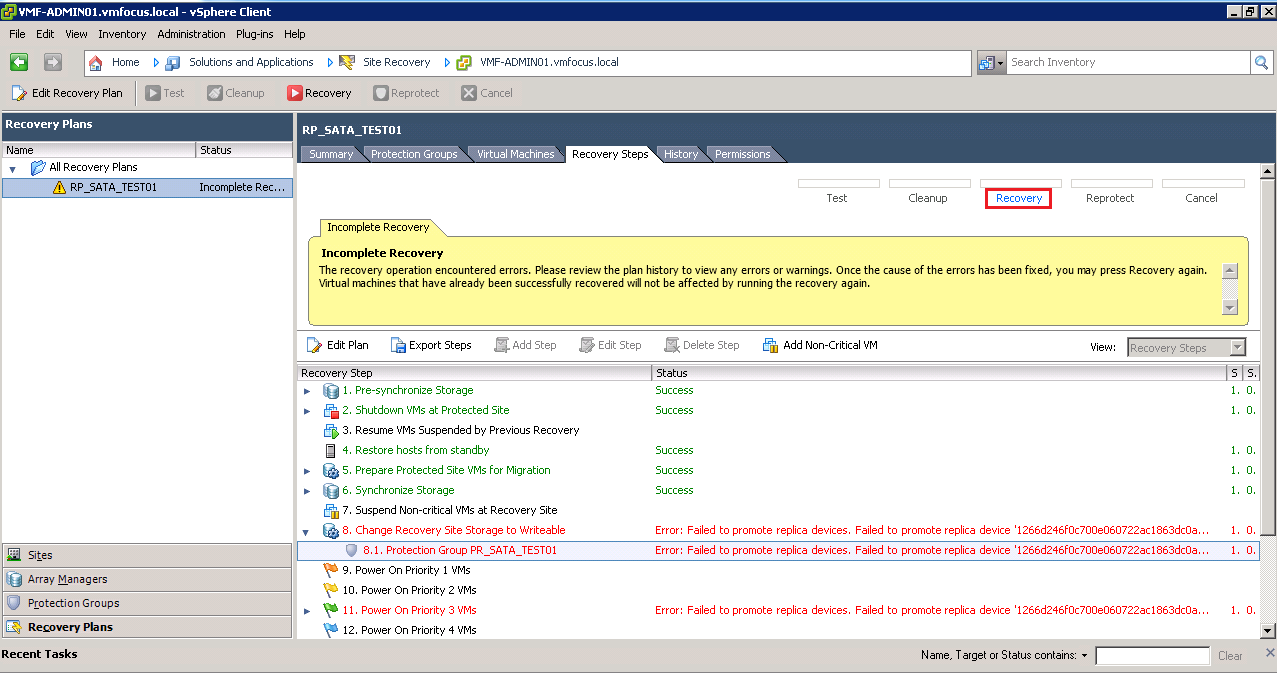
Step 5 Epic Fail!
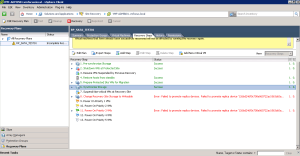
OK what happened? Well we have the error message ‘Error: Failed to promote replica devices. Failed to promote replica device ‘1266d2456f’ This means that for some reason SRM wasn’t able to promote the DR volume DR_SATA_TEST01 to Read/Write from Read. To be perfectly honest, I have tried many times to get this to work and for some reason it always fails on this step.  Strange really as when we before a test it takes a snapshot of the volume DR_SATA_TEST01 and promotes this to Read/Write without any issues. So in this situation we are going to need to give SRM a hand.

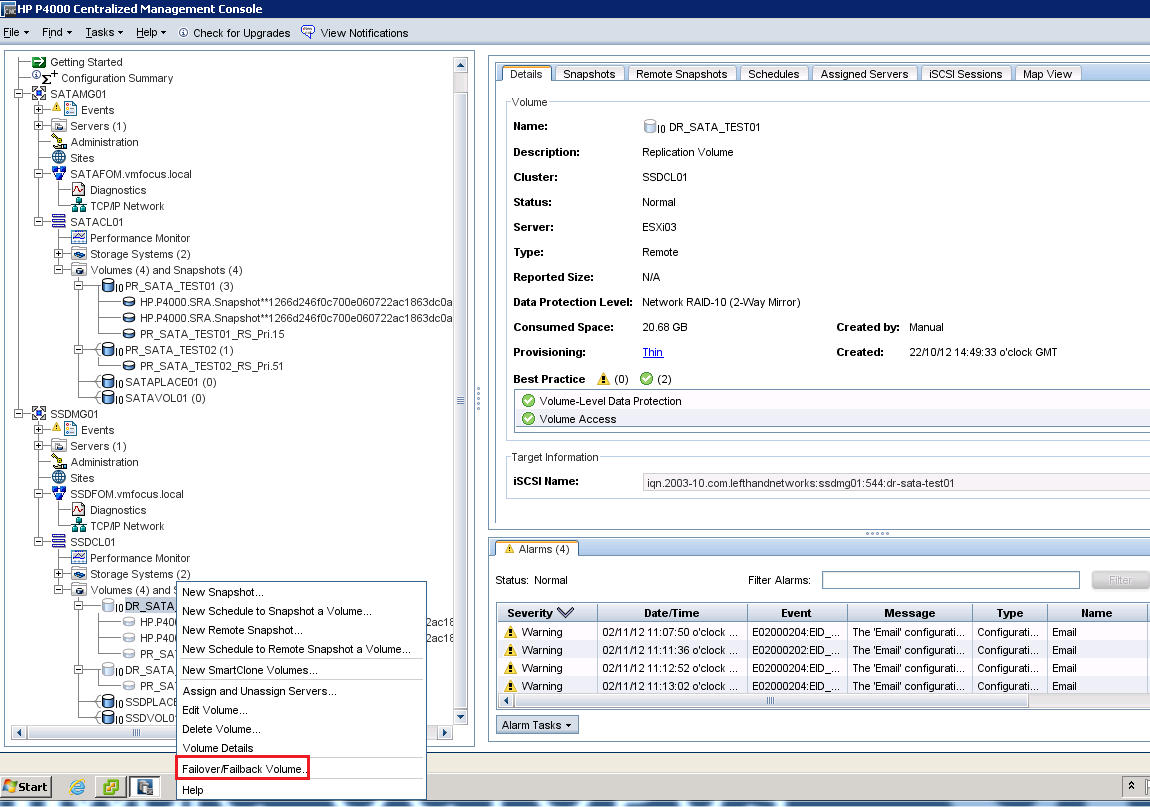
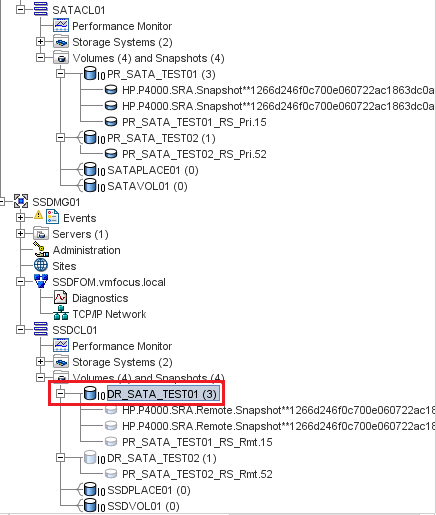
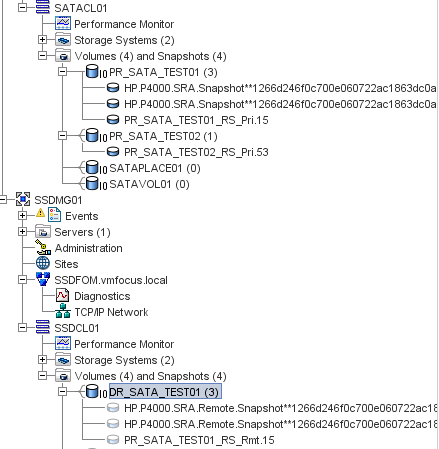
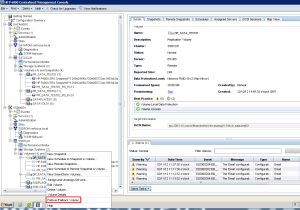
Go into the CMC and expand your Management Groups and Clusters until you get this view.

We are going to Right Click DR_SATA_TEST01 and Select Failover/Failback Volume
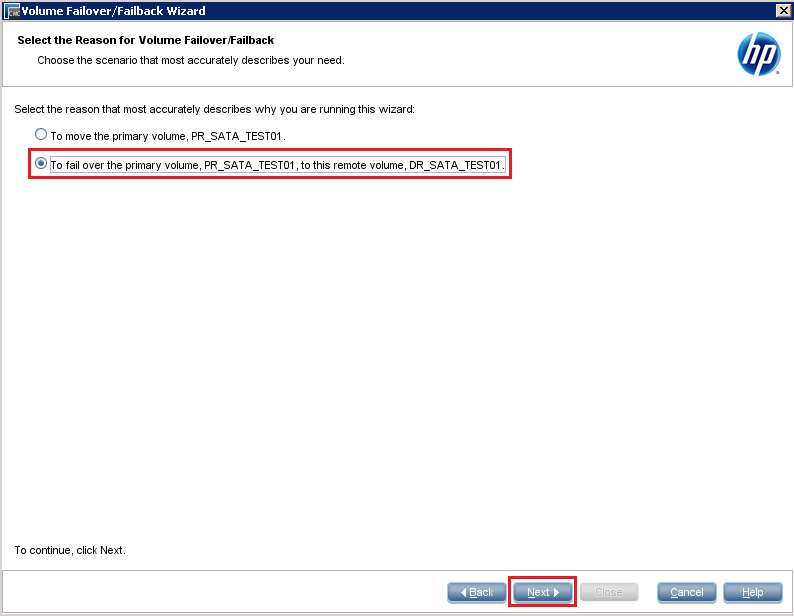
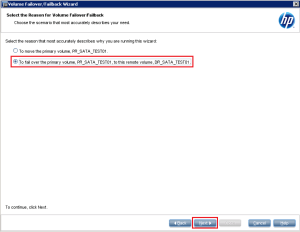
Click Next and then Select ‘to fail over the primary volume, PR_SATA_TEST01, to this remote volume, DR_SATA_TEST01 and click Next
Good news that we haven’t got any iSCSI sessions in place, so we can click Next

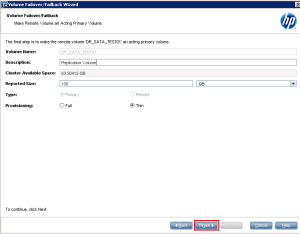
Double check your provisioning is correct, and then click Finish
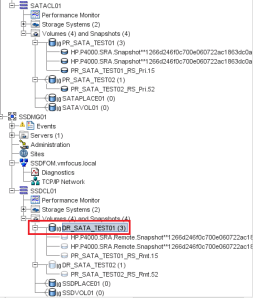
Awesome, we should now have the volume DR_SATA_TEST01 acting as a Primary Read/Write Volume, you can tell this as it should be in dark blue
I think we should try the Recovery again now, let’s hop back into SRM and click on Recovery.

Select the ‘I understand that this process will permanently alter the virtual machines and infrastructure of both the protected and recovery datacenters.’ tick box again and click Next and Start.

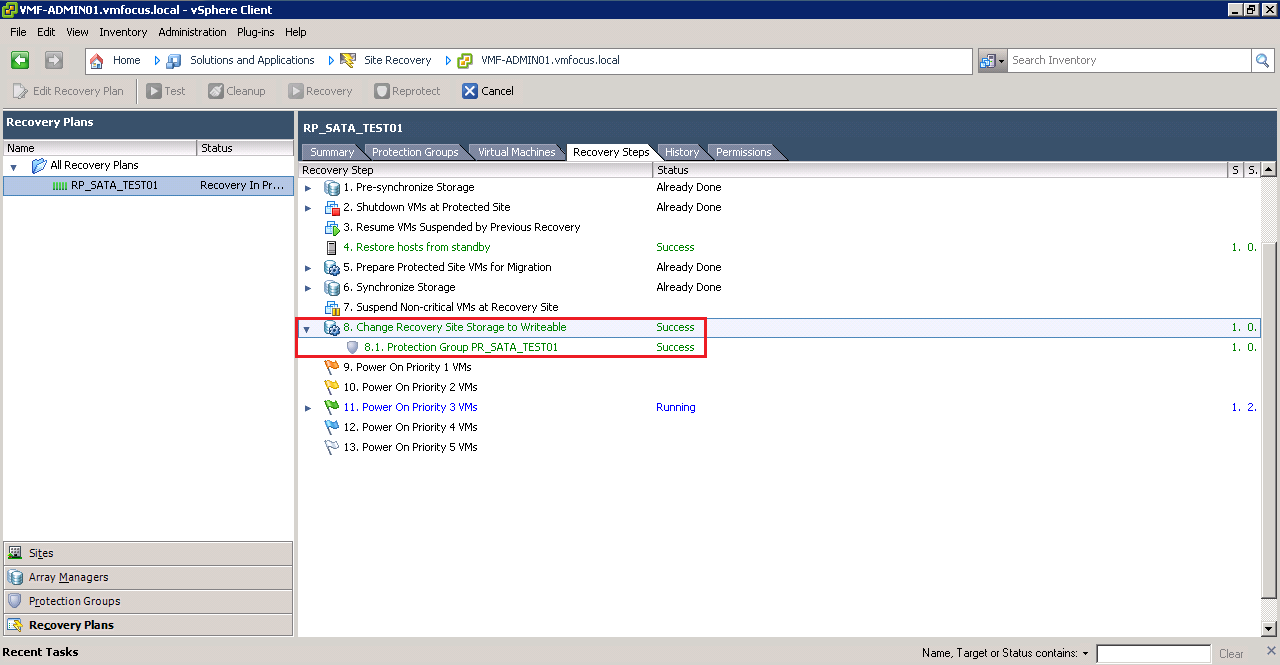
Hopefully you should see that SRM jumps straight to Step 8, Change Recovery Site Storage to Writeable and this time it has been a Success!

Time for a quick brew, whilst SRM finishes off bringing VMF-TEST01 up at our DR site.

Boom, the man from Delmonte he say yes!
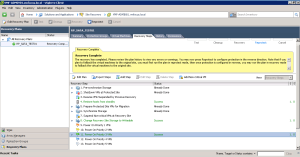
So let’s see what’s going on shall we.  First of all at our Production site.  As you can see SRM now knows that the VMF-TEST01 is not live.

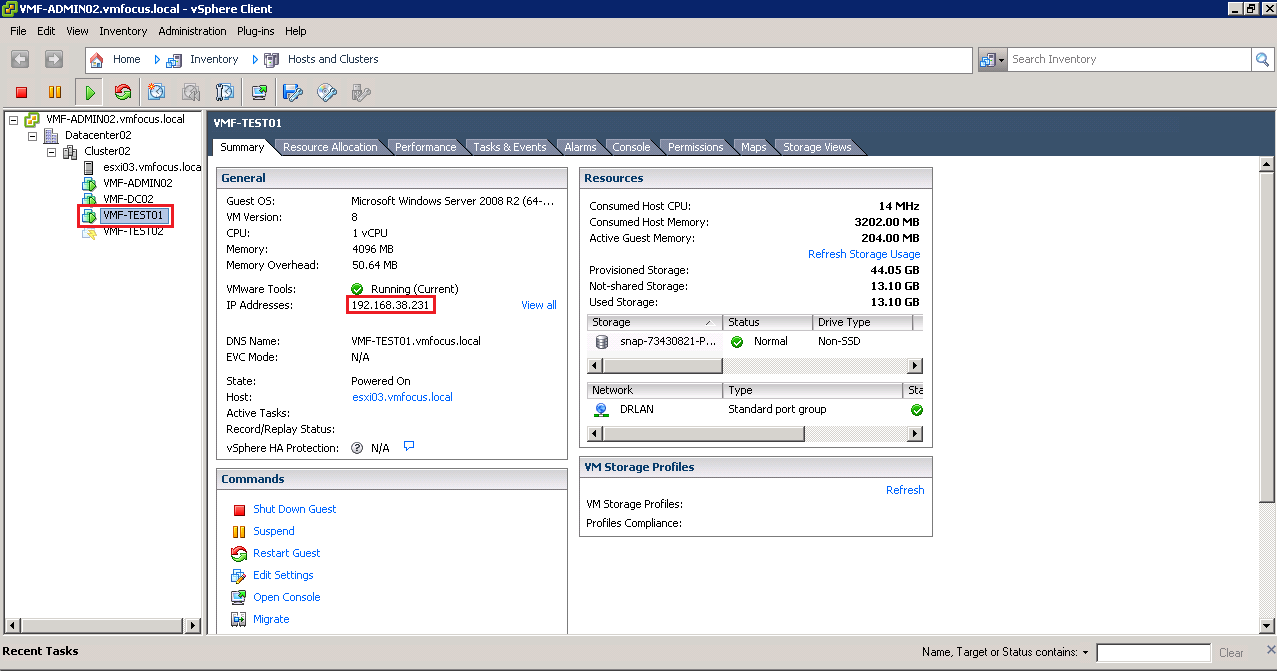
At DR, VMF-TEST01 is up and running and it’s IP Address has been successfully changed.

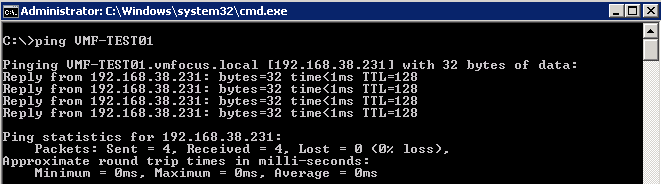
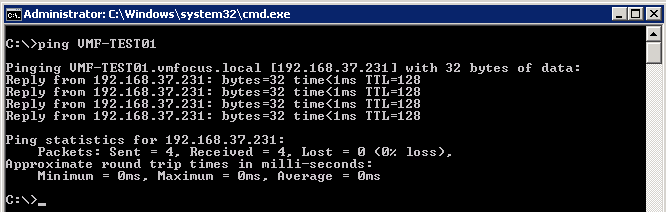
The question is can we ping it by DNS, as this should have been updated.

Boom, all working as expected.

Last of all, let’s check CMC to see what’s going on with our HP StoreVirtual VSA.
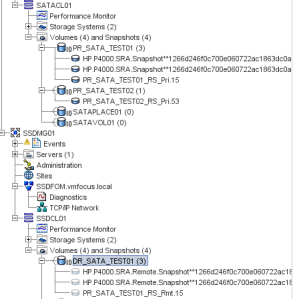
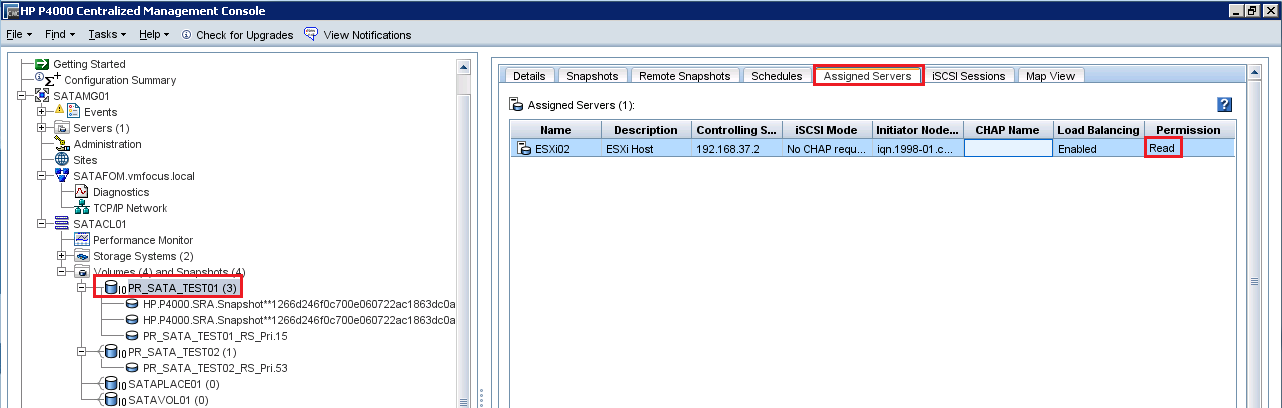
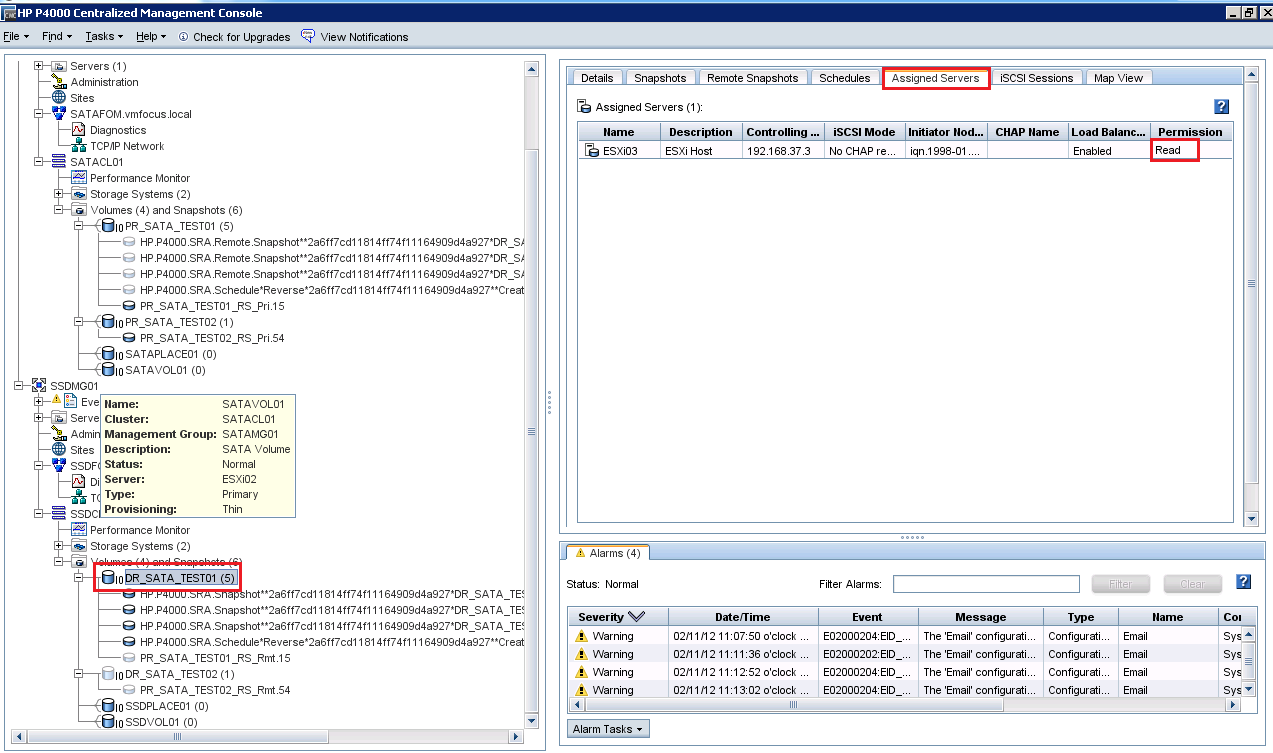
Now you may be thinking, it’s not really the best situation to be in as we have two Primary Volumes which are PR_SATA_TEST01 and DR_SATA_TEST01.  But don’t fear SRM has changed PR_SATA_TEST01 to ‘read’ only access for ESXi02
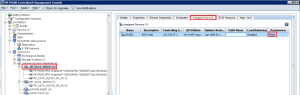
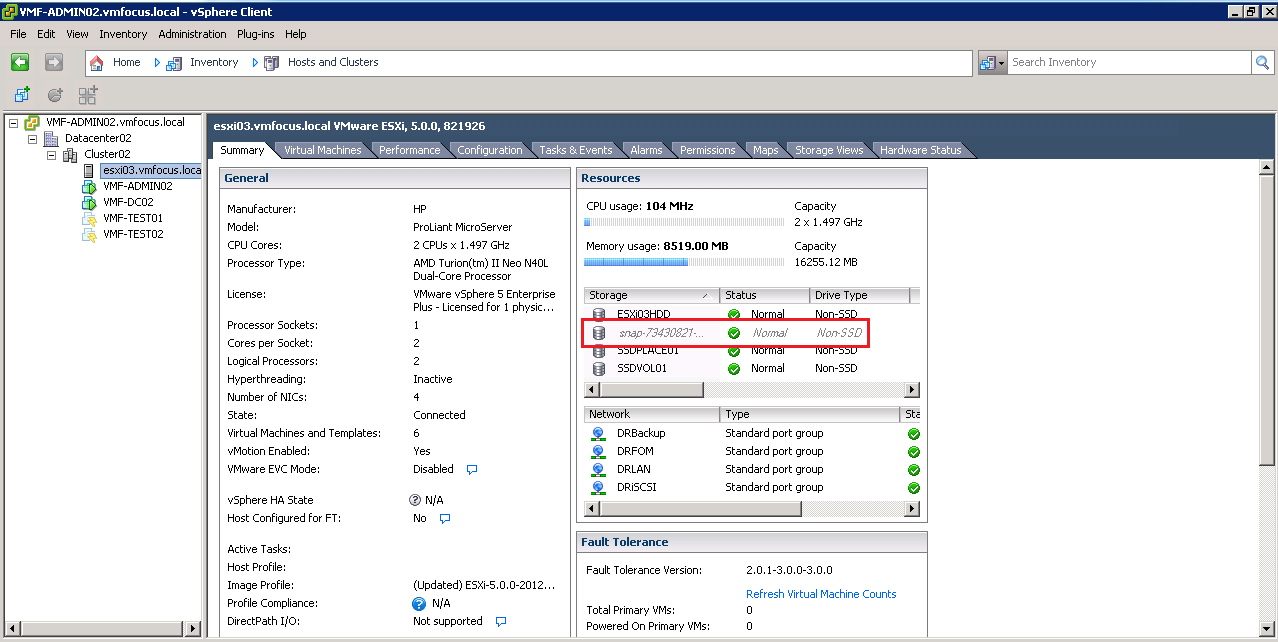
Also, if we check the Datastores on ESXi02, we see that PR_SATA_TEST01 has disappeared.

Cool, I think we are now in a position to Reprotect.

Reprotect

Reprotection reverses the process, so that the DR site becomes the protected site and Production becomes the DR site, simples.

So let’s jump back into SRM and click Reprotect
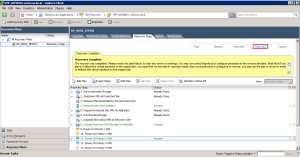
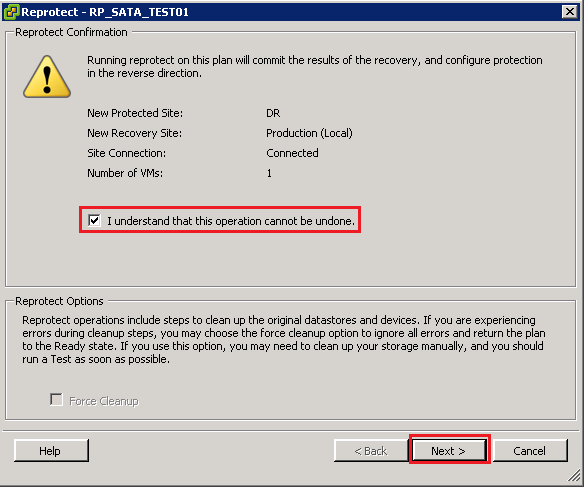
Select ‘I understand that this operation cannot be undone.’ and click Next

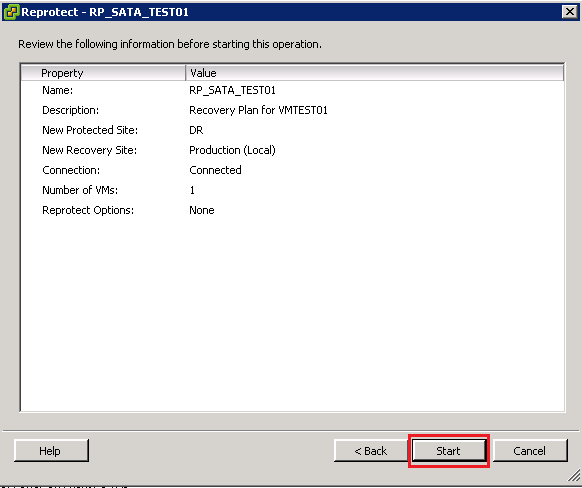
Let’s click Start and watch the process in action.
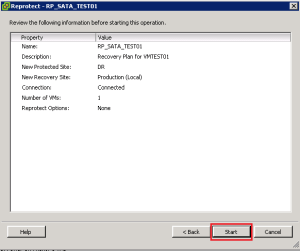
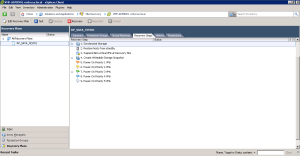
OK, what’s going on then Craig?

Step 1 SRM realises it can’t have two Primary Volumes and demotes PR_SATA_TEST01 to a Remote Volume and then deletes it

Step 2 SRM takes a snapshot of DR_SATA_TEST01 and before it starts the reverse protection as a safety measure

Step 3 SRM takes a further snapshot and invokes the replication schedule

Step 4 SRM cleans up the storage to make sure everything is ‘tickety boo’

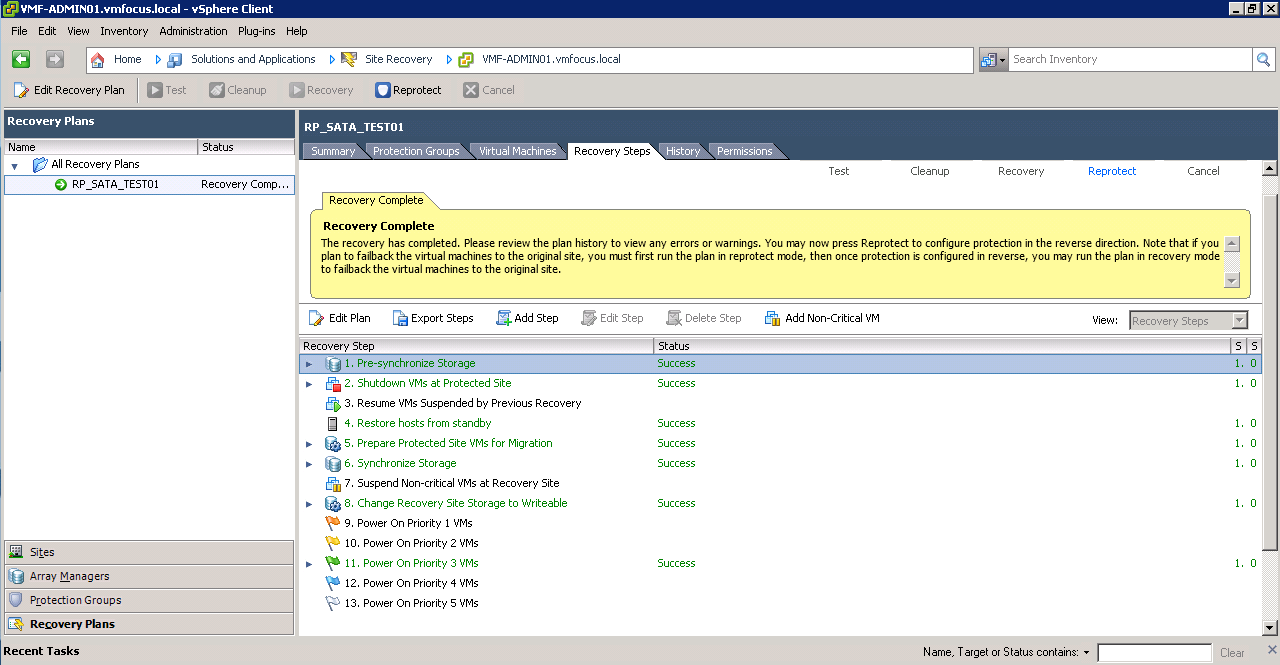
If everything was a success you should see that your Recovery Plan has gone back to normal.
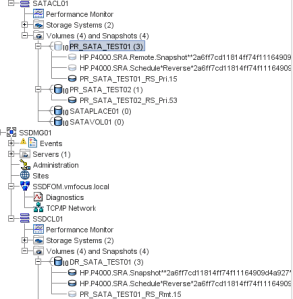
From HP StoreVirtual VSA perspective everything looks good, DR is the Primary Volume and Production is the Remote Volume
Right then, I think we should think about failing back then.  Before we do so, we need to run over that checklist again.

  • Check CMC to ensure no degraded volumes
  • Check CMC to ensure that remote copy is working correctly
  • Check vCenter to ensure that you have connectivity between sites
  • Check SRM Array Managers and refersh your Devices
  • Check Protection Groups
  • Check Recovery Plan

Once you have gone over the above list, the last thing to do is test and clean up.

Good times, everything was a success, I think we are ready to failback.

Failback

Failback is actually just a Recovery as far as SRM is concerned.  So I won’t bother waffling on about it again, so let’s hit Recovery
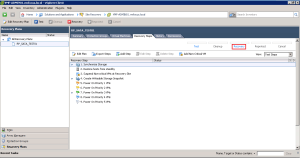
I wanted to show you that this time round, SRM was able to promote the Remote Volume to Primary Read/Write without any issues.
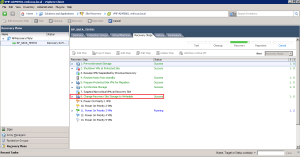
Nice one, we have another success and VMF-TEST01 is running back at Production.

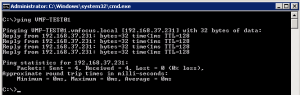
Let’s do the obligatory ping test via DNS, again success.
Quick look at our DR site and you can see SRM now sees VMF-TEST01 as being protected

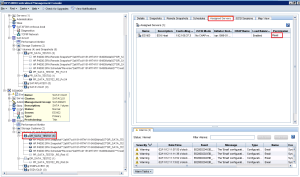
Lastly, a look at CMC to check on our HP StoreVirtual VSA, as you can see we still have two Primary copies, but again DR_SATA_TEST01 is now read only
A couple of final thoughts for you.

  1. It’s quite normal to see a ‘ghost’ datastores at either your Production or DR site after you have failed over or back. Just perform a ‘Rescan’ and it will disappear
  2. Check your path policies for the Datastore, as these don’t always go back to your preferred choice.

Thank’s for reading what probably feels like war and peace to you on SRM, I hope you agree it’s an amazing product that makes our life as the IT administrator that much easier!

How To Configure Access Lists & Route Between VLAN’s On HP v1910 24G

In the previous how to, we configured layer 3 static routes and VLAN’s on the HP v1910 24G you will have noticed that all traffic can pass between VLAN’s without any restrictions.  So why is this happening?

Well the answer is because we have turned on routing by giving an IP Address to each VLAN.  This means the HP v1910 uses it’s own routing table to send traffic from VLAN 1 to VLAN 10.

Let’s test this.  My laptop sits on VLAN 1 on IP Address 192.168.37.152 using the HP v1910G as it’s default gateway on 192.168.37.221

VLAN 1

I have five VLAN Interfaces created which can be found under Network > VLAN Interface > Summary

VLAN 2

Behind VLAN 10 is a device with IP Address 10.37.10.11, which I can ping

VLAN 3

Next, I’m going to remove the VLAN Interface for VLAN 10

VLAN 4

Don’t worry, the VLAN is still in play, we just have removed the ability to route between subnets.  Now if we ping the same device we get an epic fail.

VLAN 5

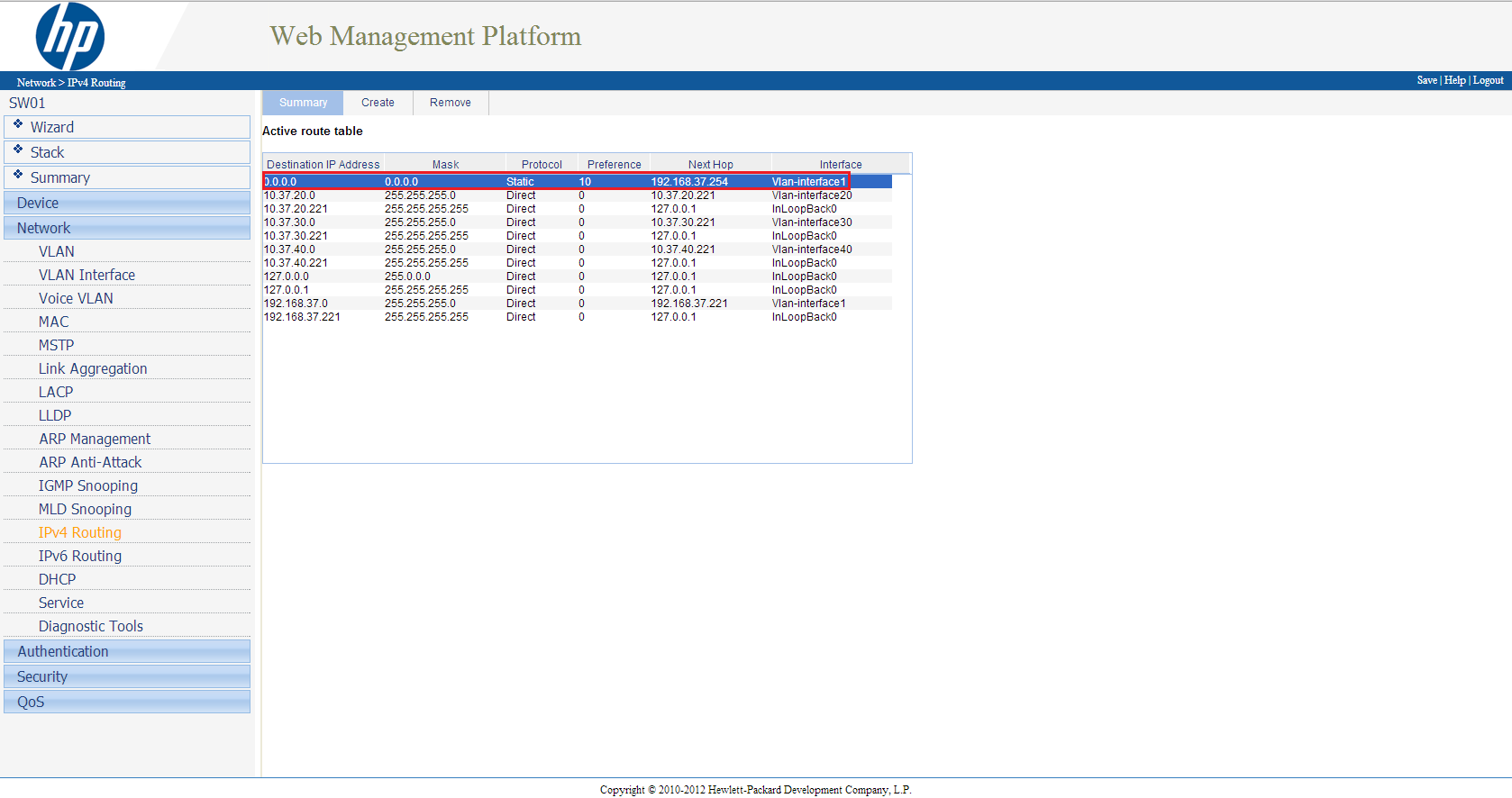
Notice we get a reply from 192.168.37.254 which isn’t an VLAN IP Address.  The reason for this is that 192.168.37.254 is the default gateway for our HP v1910G.  The HP v1910G is saying I haven’t got a clue how to get to 10.37.10.11, so let me send that traffic to my default gateway 192.168.37.254.

VLAN 6

My firewall which is on 192.168.37.254 has a static route to 10.37.10.0 255.255.255.0 via 192.168.37.221 (VLAN 1 Interface on HP v1910G).  When the HP v1910G receives the packet, it drops it as has no where to send the ICMP request.

So just to reiterate, that when we have an VLAN Interface, the HP v1910G will be able to route all traffic between VLAN’s, unless we do something about it.

Access Lists

This is where the Access List comes into play, an Access List specifies what source traffic is allowed to get to what destination traffic.  Think of it as being in a hallway in a house and all the doors are locked.  You then get given a key and you can get from the hallway into the lounge.  The source is the hallway, the destination is the lounge and the key is the Access List.

So before we move any further, I want to give you a brief explanation of what I want to be able to achieve.

My laptop resides on 192.168.37.152/24 on VLAN 1 and I want to be able to connect to my HP StoreVirtual VSA which is on 10.37.20.1/24 VLAN 20.

I also have a Windows 7 machine on 10.37.20.211/24 VLAN 20.

I want to be able to get from my laptop to 10.37.20.1, but I don’t want to let any other traffic threw.

Let’s run a ping to both devices, you can see that I have connectivity to both 10.37.20.1 HP StoreVirtual VSA and 10.37.20.221 Windows 7.

VLAN 7

So let’s create an Access List to do something about this.

Creating An Access List

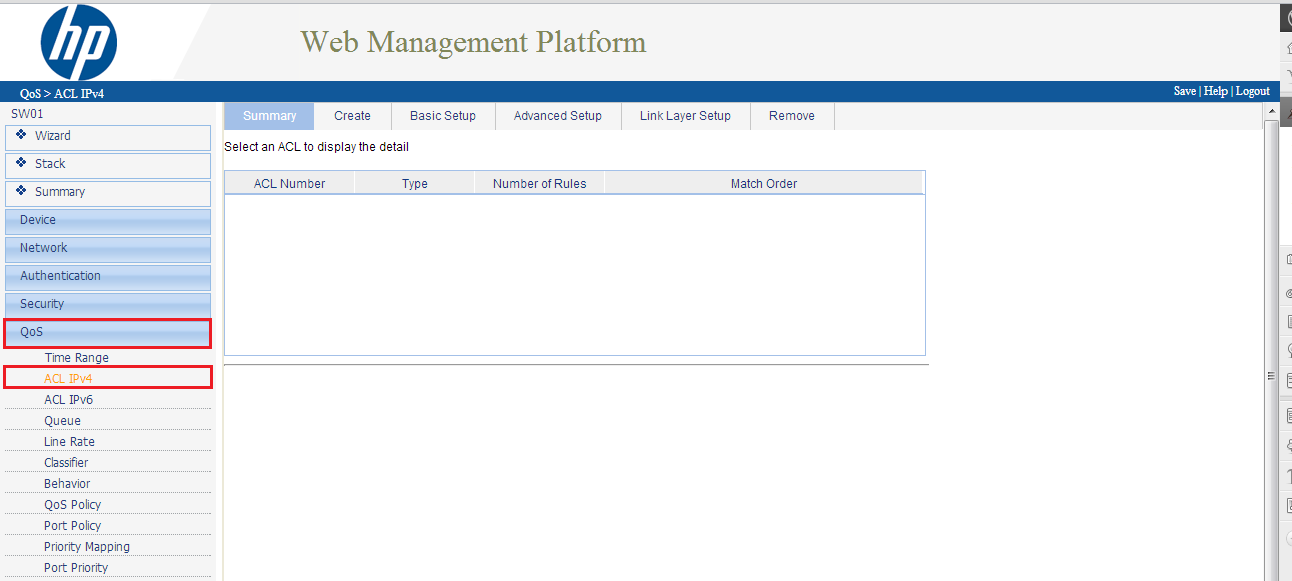
We need to go to QoS from the left hand menu then onto ACL IPv4

Next we want to select Create

Now we have a choice from Basic ACL’s, Advanced ACL’s and Ethernet Frame Header ACL’s.  OK what are the differences?

Basic ACL these only match source IPv4 address’s

Advanced ACL these match source and destination IPv4 address’s and also protocols on different port numbers e.g. TCP 80

Ethernet Frame Header ACL these match source and destination MAC addresses

With this is in mind, we are going to use Advanced ACL’s as we want to match interesting traffic from source to destination.

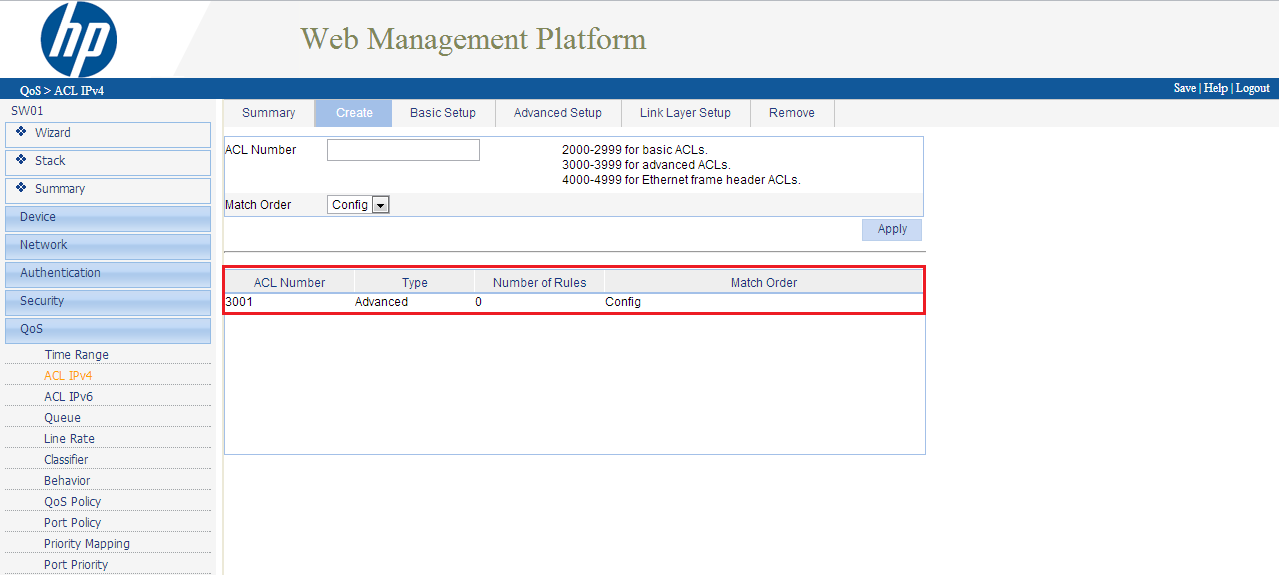
In the ACL Number section, type in 3001 and we want the match order to be Config and click Apply

You will see the ACL Number appear in the bottom table, notice we have no rules applied against it yet.

Next we want to go onto the Advanced Setup Tab at the top.  We are going to enter the following information:

  • ACL > Select 3001
  • Rule ID > Select and Enter 10
  • Action > Permit
  • Source IP Address > 192.168.37.152
  • Source Wildcard > 0.0.0.0
  • Destination IP Address > 10.37.20.1
  • Destination Wildcard > 0.0.0.0
  • Protocol > IP
  • Click Add

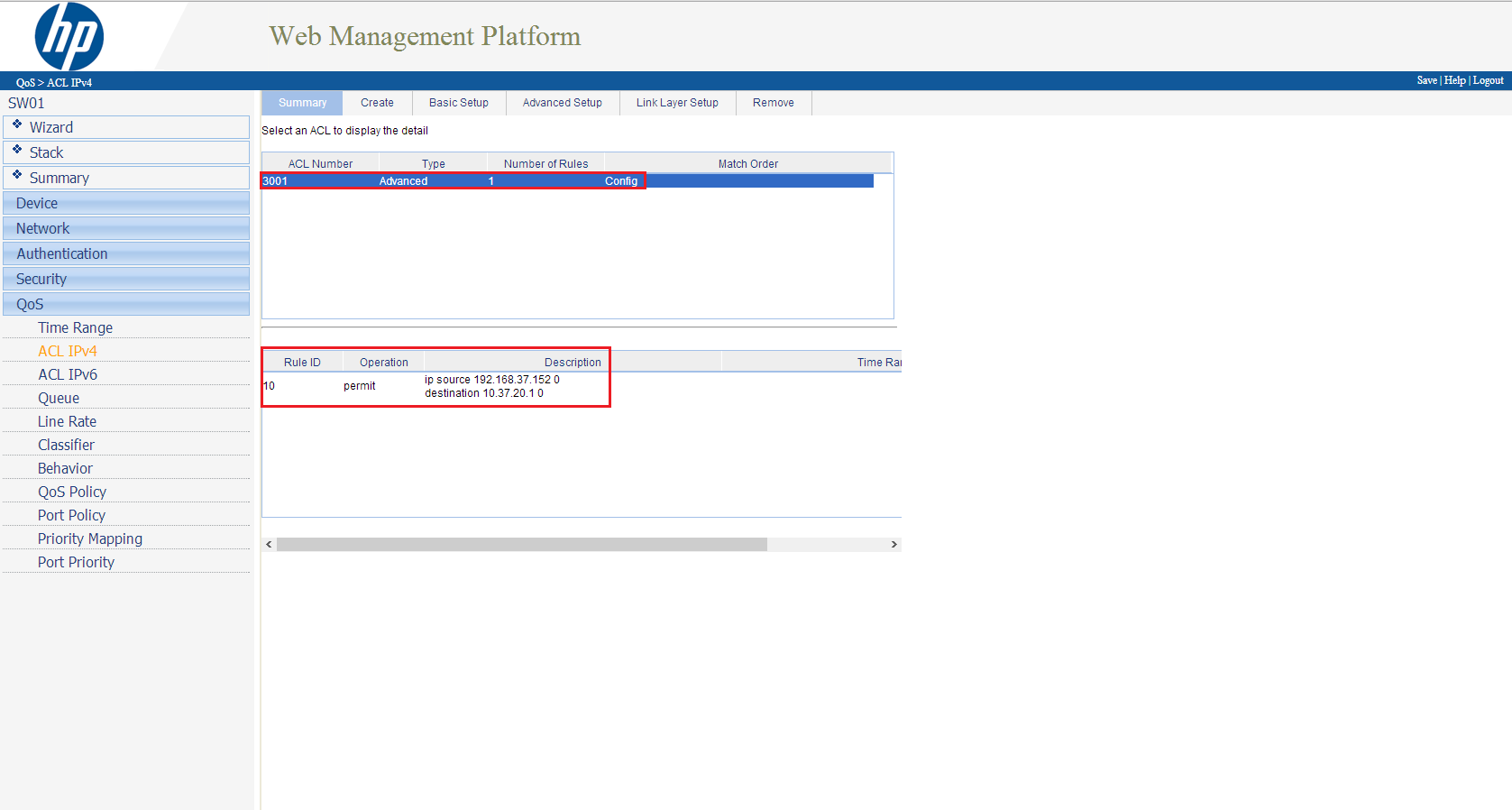
Now when you click on the Summary Tab you should see your rule in place!

VLAN 8

I want to back track slightly on some of the entries we made into the Advanced ACL, to make sure you are clear on what we did.

Rule ID this is the order in which the rules are read we entered in number 10, so this rule is read first, if you added a rule ID 9 this would get read before rule ID 10.

Wildcard this is the reverse of a normal subnet mask e.g. 255.255.255.0 becomes 0.0.0.255

TOP TIP: At the end of every Access List is always a silent deny, which means you don’t see the traffic being dropped it just happens!

Let’s see if it works shall we? Let’s ping from my laptop to a HP StoreVirtual VSA 10.37.20.1 success, what about the Windows 7 on 10.37.20.211, err also success, that’s not right!

VLAN 7

So what the heck is going on? Well as we haven’t applied the ACL3001 to an interface, everything carries on as per normal.

To be honest, applying an Access List to an interface on the HP v1910G is a royal pain.  For most switches you just choose to apply the ACL to an interface either inbound or outbound.  However, on the HP v1910G you have to perform the following:

  • Create a QoS Classifier
  • Create a QoS Behavior
  • Create a QoS Policy using the QoS Classifier and QoS Behavior
  • Apply the QoS Policy to a Port

I’m not going to run through how to do this, as examples can be found in the HP v1910G Manual page 465.

P4000: An Error Occurred While Reading The Upgrade Configuration File

With any device, it is important to keep up to date with the latest firmware the vendor can offer.

I always check the manufactures websites on a monthly basis to see if anything is new,  with this in mind, I was trying to update my P4000 StoreVirtual VSA today and I kept getting the following error message:

‘An error occurred while reading the upgrade configuration file.  If the file was from a web connection, click Try Download Again, otherwise recreate your media image’.

A quick check in Help > Preferences > Upgrades I saw that the Download Directory location didn’t look quite right.

So I entered a at the end of the Download Directory location

Clicked on OK and started the download again, voila this time it worked!

Part 3 – Automating HP StoreVirtual VSA Failover

In part two we installed and configured HP StoreVirtual VSA on vSphere 5.1 in this blog post we are going to look at automating failover.

I think a quick recap is in order.  If you remember we received a warning when adding SATAVSA01 and SATAVSA02 to the Management Group SATAMG01.  Which was:

‘to continue without installing a FOM, select the checkbox below acknowledging that a FOM is required to provide the highest level of data availability for a 2 storage system management group configuration. Then click next’.

This error message is about quorum, a term that I’m sure alot of you are familiar with when working with Windows clusters.  Each VSA run’s whats known as a ‘manager’ which is really a vote.  When we have two VSA’s we have two votes, which is a tie.  Let’s say that one VSA has an issue and goes down, how does the the remaining VSA know that? Well it doesn’t.  It could be that both VSA’s are up and they have lost’s the network between them.  This then result’s in split brain scenario.

This is where the Failover Manager comes into play.  So what exactly is a Failover Manager? Well it’s specialized version of the SAN/iQ software which runs under ESXi, VMware Player or the elephant in the room (Hyper V).  It’s purpose in life is to be a ‘manager’ and maintain quorum by introducing a third vote ensuring access to volumes in the event of a StoreVirtual VSA failure.  The Failover Manager is downloaded as an OVF and the good news is we already have a copy which we have extracted.

A few things to note about the Failover Manager.

  • Do not install the Failover Manager on a StoreVirtual VSA you want to protect,as if you have a failure the Failover Manager will loose connection.
  • Ideally it should be installed at a third physical site.
  • Bandwidth requirements to the Failover Manager should be 100 Mb/s
  • Round trip time to the Failover Manager should be no more than 50ms

In this environment we will be installing the Failover Manager on the local storage of ESXi02 and placing it into a third logical subnet.  I think a diagram and a reminder of the subnets are in order.

Right then, let’s crack on shall we.

Installing Failover Manager

We are going to deploy SATAFOM onto ESXi02 local hard drive which is called ESXi02HDD (I should get an award for my naming conventions).

The Failover Manager or FOM from now on, is an OVF so we need to deploy it from vSphere Client.  To do this click File > Deploy OVF Template.

Browse to the location of your extracted HP StoreVirtual VSA files ending in FOM_OVF_9.5.00.1215FOM.ovf

Click Next on the OVF Template Details screen and Accept the EULA followed by Next.  Give the OVF a Name in this case SATAFOM and click Next.  When you get to the storage section you need to select the local storage on a ESXi Host which is NOT running your StoreVirtual VSA.  In this case it is ESXi02HDD

Click next and select your Network Mapping and click Finish.

TOP TIP, don’t worry if you cannot select the correct network mapping during deployment. Edit the VM settings and change it manually before powering it on.

If all is going well you should see a ‘Deploying SATAFOM′ pop up box.

Whilst the FOM is deploying let’s talk networking for a minute.

On ESXi02, I have a subnet called FOM which is on VLAN 40.  We are going to pop the vNIC;s of SATAFOM into this.  The HP v1910 24G is the layer three default gateway between all the subnets and is configured with VLAN Access Lists to allow the traffic to pass (I will do a VLAN Access List blog in the future!)

Awesome let’s power the badboy on.

We need to use use the same procedure we used to set the IP address’s on the FOM as we did on the VSA.  Hopefully you should be cool with this, but if you need a helping hand refer back to How To Install & Configure HP StoreVirtual VSA On vSphere 5.1

The IP address’s I’m using are:

  • eth0 – 10.37.40.1
  • eth1 – 10.37.40.2

Failover Manager Configfuration

Time to fire up the HP Centralized Management Console (CMC) and add the IP Address into  Find Systems.

Log into view SATAFOM and it should appear as follows.

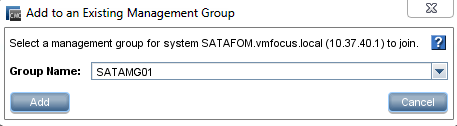
Let’s Rich Click SATAFOM and ‘Add to an Existing Management Group’ SATAMG01

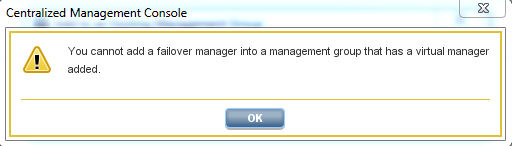
Crap, Craig that didn’t work, I got a popup about a Virtual Manager. What’s that all about?

Nows a good time as any to talk about two other ways to failover the StoreVirtual VSA.

Virtual Manager this is automatically added to a Management Group that contains an even number of StoreVirtual VSA’s.  If in the event you have a VSA failure you can start the Virtual Manager manually on the VSA which is working.  Does it work? Yes like a treat but you will have downtime until the Virtual Manager is started and you nerd to also stop it manually when the failed VSA is returned to action.  Would I use it? If you know your networking ‘onions’ you should be able configure the FOM in a third logical site to avoid this scenario.

Primary Site in a two manager configuration you can designate one manager (StoreVirtual VSA) as the Primary Site.  So if the secondary VSA goes offline you maintain quorum.  The question is why would you do this? Honestly I don’t know, because unless you have some proper ninja skills, how do you know which VSA is going to fail? Also you need to manually recover quorum, which isn’t for the feint heated.  My recommendation, simples, avoid.

OK back on topic.  We need to remove the Virtual Manager from SATAMG01, which is straight forward.  Right Click > Delete Virtual Manager.

Let’s try adding the SATAFOM back into Management Group SATAMG01.  Voila it works!  You might get a registration is required notice, we can ignore that as I’m assuming you have licensed your StoreVirtual VSA.

(I know I have some emails, they are to do with feature registration and Email settings)

Let’s Try & Break It!

Throughout this configuration we have used the following logic:

  • SATAHDD01 runs SATAVSA01
  • SATAHDD02 runs SATAVSA01
  • SATAVSA01 and SATAVSA02 are in Management Group SATAMG01
  • SATAVSA01 and SATAVSA02 have a volumes called SATAVOL01 and SATAVOL02 in Network RAID 10

In my lab I have a VM called VMF-DC01 which you guessed it is my Domain Controller, it resides on SATAVOL02.

Power Off SATAVSA01

We are going to power off SATAVSA01 which will mimic it completely failing, no shutdown guest for us!  Fingers crossed we should still maintain access to VMF-DC01.

Crap we lost connection for about 10 seconds to VMF-DC01 and then it returned whys that Craig you ask?

Well if you remember all the connections go to a Virtual IP Address in this case 10.37.10.1 This is just mask as even though the connections hit the VIP, they are directed to one of the StoreVirtual VSA, in this case SATAVSA01.

So when we powered off SATAVSA01 all the iSCSI connections had to be ceased and then represented back via the VIP to SATAVSA02.

Power Off SATAVSA02

To prove this, let’s power on SATAVSA01 and wait for quorum to be recovered.  OK let’s power off SATAVSA02 this time and see what happens.

I was browsing through folders and received a momentary pause of about one second which to be fair on a home lab environment is pretty fantastic.

So what have we learned? We can have Network RAID  1 with Hardware RAID 0 and make our infrastructure fully resilient.  To sum up, I refer back to my opening statement which was the HP StoreVirtual VSA is sheer awesomeness!